
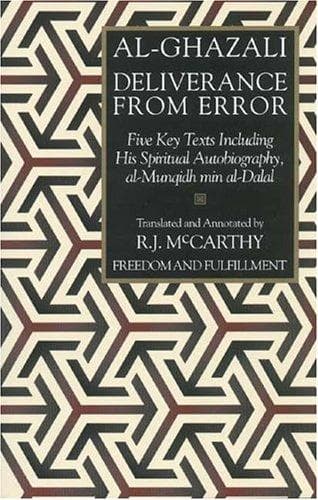
Deliverance from Error
التخليص من الضلال
Délivrance de l'erreur
Editorial summary
This autobiographical treatise presents al-Ghazali's intellectual journey through and eventual rejection of various epistemological frameworks in favor of mystical experience as the supreme path to divine knowledge. Written after his departure from Baghdad's Nizamiyyah college, the work articulates a sophisticated critique of philosophical rationalism and theological speculation while defending experiential mysticism as the most reliable means of encountering God.
Al-Ghazali structures his account as a progressive examination of four primary intellectual traditions: Islamic theology (kalam), philosophy (falsafa), Ismailism, and Sufism. He demonstrates how each system fails to provide indubitable certainty about divine reality. The theologians, he argues, remain trapped in dialectical disputes that presuppose rather than prove fundamental religious truths. The philosophers, despite their logical rigor, err in subordinating revelation to reason and compromising divine attributes through their emanationist schemes. The Ismailis' appeal to infallible authority dissolves under scrutiny, as their claimed imam cannot be verified through reliable transmission.
The work's pivotal contribution lies in its epistemological argument that rational demonstration alone cannot yield certainty about God. Al-Ghazali employs systematic doubt reminiscent of later Cartesian method, questioning even sense perception and logical principles. However, unlike Descartes, he locates the resolution not in clear and distinct ideas but in direct mystical experience (dhawq). This experiential knowledge, cultivated through Sufi practice, transcends conceptual understanding and provides immediate awareness of divine presence.
Against the philosophers, particularly al-Farabi and Ibn Sina, al-Ghazali maintains that metaphysical speculation leads to heretical conclusions about creation, divine knowledge, and resurrection. His critique significantly influenced subsequent Islamic thought by establishing boundaries between acceptable philosophical inquiry and theological orthodoxy. The work legitimizes Sufism within Sunni Islam by presenting mystical experience not as alternative to scripture but as its deepest realization.
The text's enduring significance stems from its sophisticated integration of skeptical methodology with mystical epistemology. By demonstrating reason's limitations while affirming experiential knowledge of God, al-Ghazali provides a framework that acknowledges philosophical critique while preserving religious commitment. This synthesis profoundly shaped Islamic intellectual culture and offers important insights for contemporary debates about religious experience and rational justification.
Argument formulations engaged
Related works
al-Ghazali (1110). Deliverance from Error.
@book{deliverance-from-error-1110,
  author    = {al-Ghazali},
  title     = {Deliverance from Error},
  year      = {1110},
  url       = {https://god-database.com/en/works/deliverance-from-error-1110}
}