
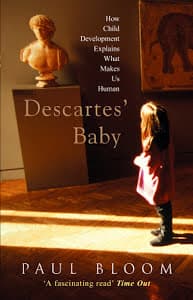
Descartes' Baby: How the Science of Child Development Explains What Makes Us Human
طفل ديكارت: كيف يفسر علم نمو الطفل ما يجعلنا بشراً
Le Bébé de Descartes : Comment la science du développement de l'enfant explique ce qui nous rend humains
Editorial summary
Paul Bloom's Descartes' Baby examines how developmental psychology illuminates fundamental aspects of human nature, particularly the innate tendency toward dualistic thinking that shapes religious belief. The work argues that humans are natural-born dualists, predisposed from infancy to view minds and bodies as distinct entities, a cognitive bias that profoundly influences how people conceptualize God and spiritual matters.
Bloom synthesizes extensive research in cognitive development to demonstrate that even very young children intuitively separate the physical world from the psychological realm. This dualistic framework, he contends, emerges not from cultural instruction but from the architecture of human cognition itself. Infants display expectations about physical objects obeying different rules than mental states, and preschoolers readily accept that while bodies die, minds or souls might persist. This developmental evidence suggests that religious concepts find fertile ground in minds already primed to think dualistically about existence.
The monograph's central contribution to debates about God lies in its naturalistic explanation for religious belief. Rather than treating religion as either divinely inspired truth or mere cultural delusion, Bloom presents it as an understandable byproduct of evolved cognitive mechanisms. The same mental faculties that allow humans to understand that others have thoughts and intentions—what psychologists term "theory of mind"—also enable and perhaps encourage belief in disembodied supernatural agents. This perspective challenges both strong theistic claims about religious revelation and dismissive atheistic accounts that treat religious belief as simply irrational.
Bloom's approach draws on experimental methods from developmental psychology while engaging broader philosophical questions about human nature. He positions his work within the tradition of cognitive science of religion, alongside scholars like Pascal Boyer and Justin Barrett, who seek evolutionary and psychological explanations for religious phenomena. However, Bloom maintains a notably neutral stance on the truth value of religious claims themselves, focusing instead on explaining why human minds find such claims intuitively compelling.
The work's significance extends beyond academic psychology to inform philosophical and theological discussions about the origins and universality of religious belief. By grounding the tendency toward religious thinking in basic features of human cognition, Bloom's analysis suggests that debates between theists and atheists must reckon with the psychological naturalness of supernatural beliefs, regardless of their ultimate truth or falsity.
Argument formulations engaged
Related works
Bloom, Paul (2004). Descartes' Baby: How the Science of Child Development Explains What Makes Us Human. Random House.
@book{descartes-baby-how-the-science-of-child-,
  author    = {Bloom, Paul},
  title     = {Descartes' Baby: How the Science of Child Development Explains What Makes Us Human},
  year      = {2004},
  publisher = {Random House},
  url       = {https://god-database.com/en/works/descartes-baby-how-the-science-of-child-development-explains-what-makes-us-human-2004}
}