
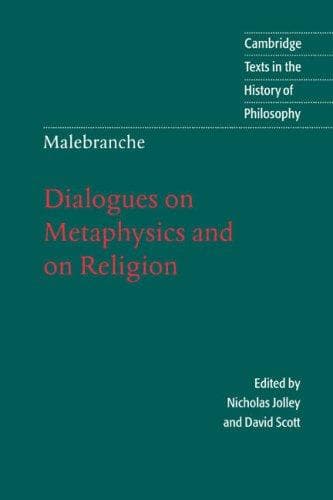
Dialogues on Metaphysics and Religion
حوارات في الميتافيزيقا والدين
Dialogues sur la métaphysique et la religion
Editorial summary
Nicolas Malebranche's Dialogues on Metaphysics and Religion represents one of the most sophisticated attempts to reconcile Cartesian philosophy with Christian theology in the late seventeenth century. Through a series of philosophical conversations between Theodore and Aristes, Malebranche constructs a comprehensive metaphysical system that places God at the absolute center of all knowledge, causation, and being.
The work's primary contribution to debates about God lies in its radical occasionalism—the doctrine that God is the only true cause of all events in the universe. Malebranche argues that what appear to be natural causes are merely occasions for God's direct action. When one billiard ball strikes another, it is not the first ball that causes movement in the second, but God who moves it according to His established laws. This position emerges from Malebranche's commitment to both Cartesian mechanism and theological orthodoxy, attempting to preserve divine sovereignty while explaining regular natural phenomena.
Central to Malebranche's argument is his theory of "vision in God," which proposes that humans perceive eternal truths and even material objects through a direct intellectual union with divine ideas. This epistemological claim serves to demonstrate God's necessity not merely as creator but as the continuous condition for all human knowledge. Against both empiricists who ground knowledge in sensation and rationalists who locate innate ideas in the human mind, Malebranche insists that truth resides in God alone, accessible through divine illumination.
The Dialogues systematically addresses objections from multiple philosophical positions. Against atheistic materialism, Malebranche argues that matter itself cannot explain the order and intelligibility of the universe. Against deism, he maintains that God's involvement with creation extends beyond initial establishment of natural laws to constant supernatural intervention. Against competing Christian philosophers, particularly Arnauld, he defends his occasionalism as the only way to preserve both divine omnipotence and the regularity of nature.
Malebranche's synthesis profoundly influenced subsequent debates about divine action, natural causation, and religious epistemology. His work challenged philosophers to reconsider the relationship between God and nature, inspiring responses from Leibniz, Berkeley, and Hume. The Dialogues remains significant for demonstrating how rigorous philosophical argument can serve explicitly theological ends, offering a model of religious rationalism that neither retreats into fideism nor capitulates to secular reasoning.
Argument formulations engaged
Related works
Malebranche, Nicolas (1688). Dialogues on Metaphysics and Religion. Cambridge University Press.
@book{dialogues-on-metaphysics-and-religion-16,
  author    = {Malebranche, Nicolas},
  title     = {Dialogues on Metaphysics and Religion},
  year      = {1688},
  publisher = {Cambridge University Press},
  url       = {https://god-database.com/en/works/dialogues-on-metaphysics-and-religion-1688}
}