
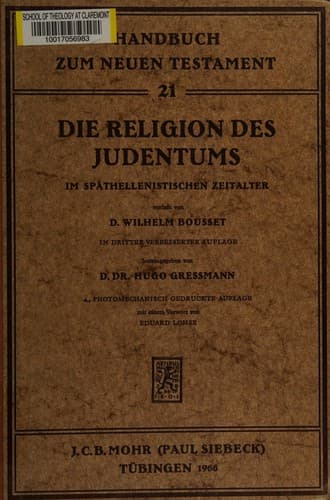
Die Religion des Judentums im späthellenistischen Zeitalter
دين اليهودية في العصر الهلنستي المتأخر
La Religion du judaïsme à l'époque hellénistique tardive
Editorial summary
Wilhelm Bousset's Die Religion des Judentums im späthellenistischen Zeitalter represents a pivotal contribution to early twentieth-century scholarship on the historical development of Jewish religious thought and its implications for understanding the emergence of Christianity. This comprehensive monograph examines Judaism during the late Hellenistic period, roughly from 200 BCE to 100 CE, analyzing how Greek philosophical concepts and cultural forms influenced Jewish theological expression while simultaneously tracing the internal evolution of Jewish religious ideas.
Bousset approaches his subject through the lens of religionsgeschichtliche methodology, situating Judaism within the broader context of Hellenistic religious syncretism. His analysis challenges earlier Protestant scholarship that portrayed late Second Temple Judaism as a legalistic degeneration from prophetic religion. Instead, Bousset argues that Hellenistic Judaism developed sophisticated theological concepts that served as crucial bridges between ancient Israelite religion and early Christian thought. He particularly emphasizes the development of intermediary figures between God and humanity, such as personified Wisdom and the Logos, which he interprets as Jewish adaptations of Greek philosophical concepts that maintained monotheistic integrity while addressing the problem of divine transcendence.
The work's significance for debates about God lies in its detailed examination of how Jewish thinkers negotiated between biblical monotheism and Hellenistic philosophical categories. Bousset demonstrates that concepts of divine transcendence became increasingly prominent in this period, leading to elaborate angelologies and theories of divine hypostases that attempted to preserve both God's absolute otherness and his continued involvement with creation. His analysis of apocalyptic literature reveals how eschatological expectations shaped contemporary understandings of divine justice and providence.
While Bousset's work reflects certain assumptions of liberal Protestant scholarship, including an evolutionary view of religious development and occasional supersessionist tendencies, his careful attention to primary sources and comparative methodology established important precedents for the academic study of ancient Judaism. His treatment of prayer, ethics, and messianic expectations in Hellenistic Judaism illuminates how theological questions about divine nature, human access to God, and theodicy were addressed within a particular historical matrix. The monograph thus provides essential historical context for understanding both the diversity of ancient Jewish theology and the intellectual environment from which early Christian theological reflection emerged.
Argument formulations engaged
Bousset, Wilhelm (1906). Die Religion des Judentums im späthellenistischen Zeitalter. Mohr Siebeck.
@book{die-religion-des-judentums-im-sp-thellen,
  author    = {Bousset, Wilhelm},
  title     = {Die Religion des Judentums im späthellenistischen Zeitalter},
  year      = {1906},
  publisher = {Mohr Siebeck},
  url       = {https://god-database.com/en/works/die-religion-des-judentums-im-sp-thellenistischen-zeitalter-1906}
}