
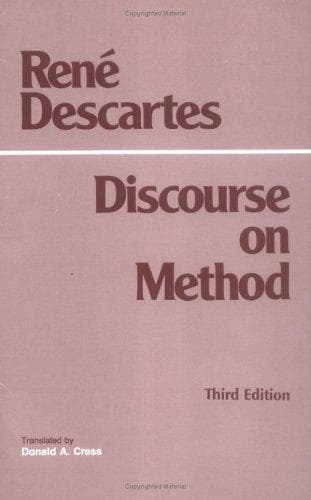
Discourse on the Method
مقال في المنهج
Discours de la méthode
Editorial summary
Rene Descartes' Discourse on the Method establishes a revolutionary philosophical approach that fundamentally reshapes the relationship between reason and faith in Western thought. Written in 1637, this work presents both a new scientific method and a metaphysical framework that attempts to secure certain knowledge of God's existence through pure rational inquiry.
Descartes begins by systematically doubting all received knowledge, including sensory experience and traditional authorities. His method of radical skepticism serves not to undermine belief but to establish indubitable foundations for knowledge. Through this process of methodical doubt, he arrives at his famous cogito ergo sum - the recognition that the very act of doubting confirms the existence of the thinking subject. This self-evident truth becomes the cornerstone for reconstructing knowledge on rational grounds.
From this foundation, Descartes develops proofs for God's existence that depart significantly from medieval scholastic arguments. He contends that the idea of an infinite, perfect being could not originate from a finite, imperfect mind. The presence of this idea in human consciousness therefore demonstrates God's existence, as only God could be its source. Furthermore, he argues that a benevolent God would not deceive humans about the basic reliability of clear and distinct ideas, thus guaranteeing the possibility of certain knowledge.
The work challenges both religious traditionalists and emerging materialist philosophers. Against the former, Descartes insists that faith must submit to rational examination. Against the latter, he maintains that proper rational method leads inevitably to theistic conclusions. His mechanistic view of the physical world, combined with arguments for the soul's immateriality, attempts to preserve space for both modern science and religious belief.
Descartes' contribution to debates about God proves deeply influential yet controversial. By grounding theology in individual reason rather than ecclesiastical authority or scriptural revelation, he opens new possibilities for natural theology while simultaneously exposing religious belief to rational critique. His confidence that reason necessarily leads to God faces immediate challenges from philosophers who employ his own method to reach different conclusions. The Discourse thus marks a crucial turning point where the question of God becomes inseparable from questions about the nature and limits of human reason itself.
Argument formulations engaged
Related works
Descartes, Rene (1637). Discourse on the Method. Jan Maire (Leiden).
@book{discourse-on-the-method-1637,
  author    = {Descartes, Rene},
  title     = {Discourse on the Method},
  year      = {1637},
  publisher = {Jan Maire (Leiden)},
  url       = {https://god-database.com/en/works/discourse-on-the-method-1637}
}