
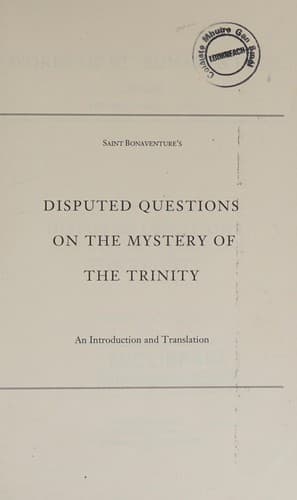
Disputed Questions on the Mystery of the Trinity
مسائل متنازع عليها في سر الثالوث
Questions disputées sur le mystère de la Trinité
Editorial summary
Bonaventure's Disputed Questions on the Mystery of the Trinity represents a pivotal contribution to 13th century scholastic theology, offering a sophisticated defense of Trinitarian doctrine through the synthesis of Augustinian tradition with Aristotelian philosophical methods. Writing at the University of Paris during the height of medieval scholasticism, Bonaventure engages with the central theological challenge of reconciling the unity of God with the distinction of three divine persons.
The work emerges from the quaestiones disputatae format, wherein theological propositions undergo rigorous dialectical examination through objections and responses. Bonaventure structures his investigation around fundamental questions concerning divine processions, relations, and persons within the Trinity. His approach demonstrates particular concern with defending orthodox Trinitarian theology against both modalist tendencies that collapse personal distinctions and tritheistic interpretations that compromise divine unity.
Central to Bonaventure's argument is his development of the concept of relation as the basis for personal distinction within the Godhead. Drawing heavily from Augustine while incorporating Aristotelian categories, he argues that the divine persons are constituted by relations of origin that are identical with the divine essence yet establish real distinctions. The Father's unbegottenness, the Son's generation, and the Spirit's procession constitute subsistent relations that neither divide the divine substance nor reduce to mere mental distinctions.
The work engages critically with contemporary debates, particularly addressing Peter Lombard's Sentences and responding to various interpretations circulating in Parisian theological circles. Bonaventure's method combines rigorous logical analysis with contemplative theology, reflecting his Franciscan commitment to affective as well as speculative knowledge of God. His treatment of divine exemplarism and the psychological analogy for the Trinity reveals the influence of Augustine's De Trinitate while advancing original insights regarding the metaphysics of divine personhood.
Bonaventure's contribution proves significant for establishing a via media between purely philosophical approaches to God and anti-intellectual fideism. His careful balance of reason and revelation, coupled with his insistence that Trinitarian doctrine represents the highest truth accessible to human understanding, positions this work as foundational for subsequent scholastic theology. The text's influence extends through later Franciscan theology and continues to inform contemporary discussions of divine simplicity, personhood, and the relationship between philosophical theology and revealed doctrine.
Argument formulations engaged
Bonaventure (1255). Disputed Questions on the Mystery of the Trinity.
@book{disputed-questions-on-the-mystery-of-the,
  author    = {Bonaventure},
  title     = {Disputed Questions on the Mystery of the Trinity},
  year      = {1255},
  url       = {https://god-database.com/en/works/disputed-questions-on-the-mystery-of-the-trinity-1255}
}