
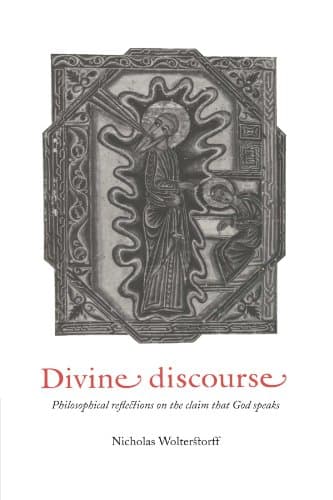
Divine Discourse: Philosophical Reflections on the Claim that God Speaks
الخطاب الإلهي: تأملات فلسفية في ادعاء أن الله يتكلم
Discours divin : Réflexions philosophiques sur l'affirmation que Dieu parle
Editorial summary
Nicholas Wolterstorff's Divine Discourse addresses a fundamental yet often neglected question in philosophy of religion: what does it mean to claim that God speaks? Rather than treating divine speech as merely metaphorical or dismissing it as philosophically naive, Wolterstorff develops a sophisticated account of how discourse about God speaking can be understood as literal and philosophically defensible.
The work emerges within the context of speech act theory and analytic philosophy of language, drawing particularly on J.L. Austin's insights while extending them to theological discourse. Wolterstorff challenges both the philosophical tendency to reduce all God-talk to human projection and the theological inclination to treat divine speech as sui generis, beyond philosophical analysis. His central thesis holds that God can and does perform illocutionary acts—making promises, issuing commands, offering forgiveness—through the appropriation of human discourse, particularly biblical texts.
Wolterstorff argues against two dominant interpretative traditions. First, he critiques the propositional model of revelation associated with conservative theology, which reduces divine speech to the communication of timeless truths. Second, he challenges the expressivist tradition stemming from Schleiermacher, which treats religious texts as merely human expressions of religious experience rather than genuine divine discourse. Instead, he proposes a "divine appropriation" model: God speaks by appropriating human discourse for divine purposes, much as one person might speak by authorizing another to speak on their behalf.
The philosophical significance of this project extends beyond theology proper. Wolterstorff demonstrates how speech act theory illuminates religious discourse while simultaneously showing how theological cases push the boundaries of standard philosophical accounts of language. His analysis of how a transcendent being might engage in linguistic acts with temporal creatures offers insights into broader questions about communication, agency, and interpretation.
The work's lasting contribution lies in its rigorous philosophical defense of taking seriously the claim that God speaks, without retreating into fideism or metaphor. By showing how divine discourse can be understood within a broader philosophical framework while respecting its distinctive features, Wolterstorff opens new possibilities for dialogue between analytic philosophy and theology. His approach suggests that philosophical tools need not diminish religious claims but can instead clarify and defend their coherence.
Argument formulations engaged
Wolterstorff, Nicholas (1995). Divine Discourse: Philosophical Reflections on the Claim that God Speaks. Cambridge University Press.
@book{divine-discourse-philosophical-reflectio,
  author    = {Wolterstorff, Nicholas},
  title     = {Divine Discourse: Philosophical Reflections on the Claim that God Speaks},
  year      = {1995},
  publisher = {Cambridge University Press},
  url       = {https://god-database.com/en/works/divine-discourse-philosophical-reflections-on-the-claim-that-god-speaks-1995}
}