
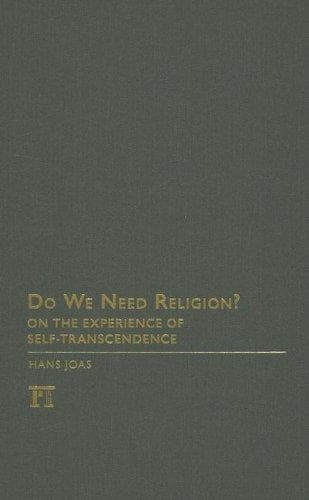
Do We Need Religion?
هل نحتاج إلى الدين؟
Avons-nous besoin de la religion ?
Editorial summary
The celebrated German sociologist Hans Joas presents a compelling examination of religion's contemporary relevance through the lens of social theory and historical sociology. Rather than approaching the question of religion's necessity through traditional theological or philosophical channels, Joas employs a distinctive sociological methodology that combines empirical observation with theoretical reflection on the nature of human values and social meaning.
Joas situates his analysis within the broader context of secularization theory, critically engaging with the work of Charles Taylor, Jürgen Habermas, and other prominent theorists who have examined religion's changing role in modern society. He challenges the conventional secularization narrative that assumes religion's inevitable decline, arguing instead for a more nuanced understanding of religious transformation in contemporary contexts. His approach draws heavily on American pragmatism, particularly the insights of William James and John Dewey, to develop what he terms a "pragmatist theory of religion."
Central to Joas's argument is the concept of "self-transcendence" and the formation of strong evaluative commitments. He contends that religion addresses fundamental human experiences of contingency, suffering, and the need for meaning that cannot be fully satisfied by secular alternatives. However, Joas avoids both simplistic religious apologetics and reductive secularist dismissals. Instead, he develops a sophisticated account of how religious traditions function as repositories of collective wisdom and frameworks for moral orientation.
The work engages critically with both defenders and critics of religion's public role. Against strict secularists, Joas argues that excluding religious voices from public discourse impoverishes democratic deliberation. Against religious fundamentalists, he maintains that religious truth claims must be articulated in ways accessible to pluralistic societies. His analysis of specific cases, including civil religion in America and the role of Christianity in European identity, demonstrates how religious traditions continue to shape collective values even in supposedly secular contexts.
Joas's contribution to debates about God lies not in arguing for or against divine existence, but in reframing the question of religion's necessity in terms of its irreducible contribution to human flourishing and social cohesion. His work suggests that rather than asking whether we need religion in abstract terms, we should examine how religious traditions actually function in addressing perennial human concerns. This sociological approach offers fresh perspectives on why religious questions persist despite predictions of their disappearance.
Argument formulations engaged
Joas, Hans (2008). Do We Need Religion?. Routledge.
@book{do-we-need-religion-2008,
  author    = {Joas, Hans},
  title     = {Do We Need Religion?},
  year      = {2008},
  publisher = {Routledge},
  url       = {https://god-database.com/en/works/do-we-need-religion-2008}
}