
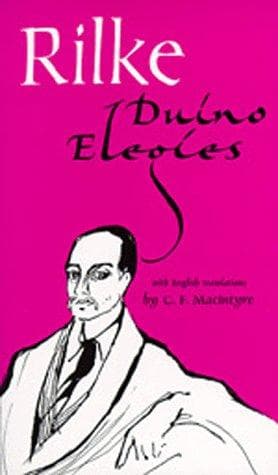
Duino Elegies
مراثي دوينو
Élégies de Duino
Editorial summary
Rainer Maria Rilke's Duino Elegies represents one of modern literature's most profound meditations on divine absence and human spiritual longing. Composed over a decade and completed in 1922, this cycle of ten elegies explores the crisis of meaning in a world where traditional religious certainties have dissolved, yet where the human need for transcendence remains acute. The work constitutes a significant contribution to early twentieth-century discourse on the sacred, offering neither conventional theism nor atheistic rejection, but rather a complex phenomenology of spiritual experience in modernity.
The elegies begin with the famous invocation questioning whether any angel would hear human cries, immediately establishing the central problematic of divine distance. Throughout the sequence, Rilke develops a distinctive theology of absence, where angels function not as Christian messengers but as figures of terrible beauty representing orders of being fundamentally alien to human experience. This reimagining of angelology serves to articulate the unbridgeable gap between human consciousness and any putative divine realm, while simultaneously affirming the reality and significance of that gap as constitutive of human existence itself.
Rilke's method combines intense lyrical introspection with philosophical reflection, drawing on his encounters with phenomenology and existential thought while maintaining a fundamentally poetic rather than systematic approach. The work engages implicitly with Nietzschean themes of divine death and self-overcoming, yet resists both nihilistic conclusions and facile humanistic substitutions. Instead, the elegies propose what might be termed a negative theology of experience, where the impossibility of traditional religious affirmation becomes itself a mode of spiritual practice.
The elegies' treatment of death, love, and artistic creation reveals Rilke's vision of human existence as fundamentally liminal, caught between animal immediacy and angelic transcendence without possibility of resolution. This condition generates both suffering and the possibility of a distinctively human form of praise. The ninth and tenth elegies develop this theme toward a culminating vision of affirmation that embraces rather than overcomes limitation.
Rilke's contribution to theological discourse lies in his articulation of a post-religious spirituality that neither retreats into nostalgia nor advances toward secular substitution. The Duino Elegies remains influential for contemporary discussions of religion and literature, offering resources for thinking about the sacred beyond traditional theistic categories while maintaining the seriousness of ultimate questions.
Argument formulations engaged
Rilke, Rainer Maria (1923). Duino Elegies.
@book{duino-elegies-1923,
  author    = {Rilke, Rainer Maria},
  title     = {Duino Elegies},
  year      = {1923},
  url       = {https://god-database.com/en/works/duino-elegies-1923}
}