
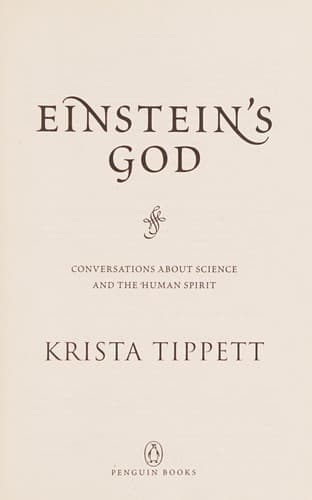
Einstein's God.. Conversations about Science and the Human Spirit
إله أينشتاين.. محادثات حول العلم والروح الإنسانية
Le Dieu d'Einstein.. Conversations sur la science et l'esprit humain
The encounter between science and the human spirit is not a conflict but a generative conversation in which scientists, theologians, and thinkers together probe the deepest questions of meaning, mystery, and transcendence.
Editorial summary
Krista Tippett's Einstein's God: Conversations about Science and the Human Spirit explores the intersection of scientific inquiry and spiritual meaning through a series of dialogues with leading scientists, mathematicians, and physicians. The work takes its title from Einstein's famous assertion that he believed in "Spinoza's God," a conception that locates divinity within the mathematical elegance and ordered beauty of the natural world rather than in a personal deity who intervenes in human affairs.
Tippett, drawing on her experience as host of the public radio program "On Being," employs an interview-based methodology that privileges personal narrative and lived experience alongside intellectual argument. Her interlocutors include Freeman Dyson, Paul Davies, Sherwin Nuland, and V.V. Raman, among others. Through these conversations, she investigates how contemporary scientists navigate questions of meaning, purpose, and transcendence within their professional disciplines. The work deliberately avoids the adversarial framing that often characterizes science-religion debates, instead revealing how many practicing scientists maintain nuanced positions that resist simple categorization as either religious or secular.
The book's central contribution lies in its demonstration that scientific practice itself can generate what participants describe as spiritual experiences—moments of awe, wonder, and connection to something greater than oneself. Tippett documents how mathematical physicists speak of beauty and elegance in equations with language typically reserved for aesthetic or religious experience, and how physicians confront ultimate questions through their encounters with human mortality and resilience. These testimonies complicate standard narratives about the incompatibility of scientific and religious worldviews.
Methodologically, Tippett's approach represents a form of philosophical journalism that prioritizes dialogue over debate. She creates space for her subjects to articulate positions that often fall between conventional categories, revealing how questions about God persist even among those who reject traditional religious frameworks. The work challenges both militant atheism and fundamentalist religion by presenting voices that find sacred dimensions within scientific practice itself. While some critics might fault the book for its lack of systematic philosophical argumentation, its value lies precisely in documenting how working scientists actually think about ultimate questions, rather than how philosophical combatants claim they should think. The result illuminates a middle ground in contemporary discussions about science and spirituality that often goes unacknowledged in more polemical treatments.
Structured analysis
Structure of the work
Argument formulations engaged
Tippett, Krista (2010). Einstein's God.. Conversations about Science and the Human Spirit. Penguin Books.
@book{einsteins-god-conversations-about-scienc,
  author    = {Tippett, Krista},
  title     = {Einstein's God.. Conversations about Science and the Human Spirit},
  year      = {2010},
  publisher = {Penguin Books},
  url       = {https://god-database.com/en/works/einsteins-god-conversations-about-science-and-the-human-spirit}
}