
Encyclopedia of Philosophy
موسوعة الفلسفة
Encyclopédie de philosophie
Editorial summary
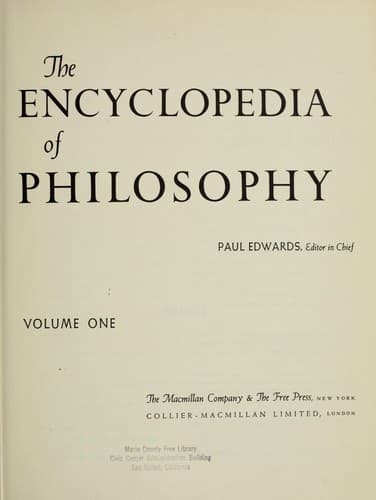
The Encyclopedia of Philosophy, edited by Paul Edwards and published in 1967, represents a watershed moment in mid-twentieth century Anglo-American philosophical scholarship on religious questions. This eight-volume compendium assembles critical assessments of theistic arguments, atheistic critiques, and agnostic positions from leading philosophers of the era, establishing itself as an authoritative reference work that shaped subsequent philosophical discourse about God.
Edwards's editorial approach reflects the analytical philosophy tradition dominant in English-speaking universities during the 1960s. The encyclopedia treats religious concepts through rigorous logical analysis, emphasizing clarity of argumentation over theological speculation. Articles on classical proofs for God's existence receive particularly thorough treatment, with contributors dissecting the ontological, cosmological, and teleological arguments using the tools of modern logic. The work notably includes substantial coverage of atheistic philosophy, featuring comprehensive entries on figures like Feuerbach, Marx, and Nietzsche, alongside contemporary critics of religion such as Antony Flew and J.J.C. Smart.
The encyclopedia's treatment of God reflects the philosophical climate following logical positivism's decline. While earlier positivists had dismissed religious language as meaningless, contributors to Edwards's volumes engage substantively with theistic claims while maintaining skeptical scrutiny. Articles examine the coherence of divine attributes, the problem of evil, and the relationship between faith and reason. The work incorporates emerging discussions in philosophy of religion, including Alvin Plantinga's early modal arguments and responses to Wittgensteinian approaches to religious language.
Edwards's editorial stance shapes the encyclopedia's approach to religious topics. Known for his atheistic position and critique of theology, Edwards nonetheless ensures balanced representation of diverse viewpoints. The selection of contributors and topics reveals careful attention to both historical and contemporary debates, though with evident emphasis on analytical rather than continental approaches to religious philosophy.
The encyclopedia's significance extends beyond its immediate reference value. It codified mid-century analytical philosophy's approach to religious questions, establishing frameworks that would dominate English-language philosophy of religion for decades. Its comprehensive bibliographies and cross-references created an intellectual map of the God debate as understood in 1967, preserving a crucial moment when analytical philosophy was asserting its methods against both traditional theology and existentialist approaches to religious questions.
Related works
Edwards, Paul (1967). Encyclopedia of Philosophy. Routledge.
@book{encyclopedia-of-philosophy-1967,
  author    = {Edwards, Paul},
  title     = {Encyclopedia of Philosophy},
  year      = {1967},
  publisher = {Routledge},
  url       = {https://god-database.com/en/works/encyclopedia-of-philosophy-1967}
}