
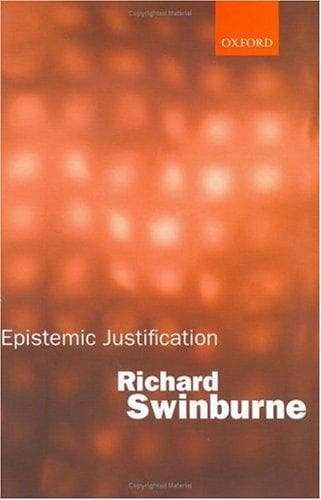
Epistemic Justification
التبرير المعرفي
Justification épistémique
Editorial summary
This monograph presents a comprehensive theory of epistemic justification that grounds knowledge claims in basic beliefs and probabilistic reasoning. Swinburne develops a foundationalist epistemology that has significant implications for evaluating religious beliefs, particularly arguments for God's existence.
The work begins by distinguishing between synchronic justification (what makes beliefs justified at a particular time) and diachronic justification (how beliefs become justified over time). Swinburne argues that certain basic beliefs require no further justification, including beliefs about one's own mental states, apparent memories, and perceptual experiences. These foundational beliefs provide the starting point for all other knowledge claims.
Central to Swinburne's approach is his principle of credulity: in the absence of defeaters, things are probably as they seem. This principle extends to religious experiences, suggesting that apparent experiences of God provide prima facie justification for belief in God's existence. He couples this with a principle of testimony, arguing that we should generally trust what others report unless we have specific reasons for doubt.
The monograph develops a sophisticated framework for assessing the probability of beliefs based on available evidence. Swinburne employs Bayesian probability theory to show how background beliefs, new evidence, and explanatory power combine to determine the rational credibility of propositions. This probabilistic approach allows for degrees of belief rather than simple acceptance or rejection of claims.
Particularly relevant to debates about God is Swinburne's discussion of simplicity as a criterion for theory choice. He argues that simpler hypotheses have greater prior probability, a principle he later applies to arguments for theism. The work also addresses the problem of induction and the justification of scientific theories, providing tools for comparing competing worldview explanations.
The epistemological framework developed here underpins Swinburne's later arguments for God's existence, especially his cumulative case approach. By establishing when belief in testimony and experience is rational, and how to weigh competing explanations, the work provides methodological foundations for natural theology. Critics have challenged both the principle of credulity and the application of simplicity to metaphysical questions, but Swinburne's systematic approach has influenced how philosophers evaluate religious knowledge claims. The monograph demonstrates how general epistemological principles can be applied to specific questions about religious belief, making it a significant contribution to philosophy of religion.
Argument formulations engaged
Related works
Swinburne, Richard (2001). Epistemic Justification. Oxford University Press.
@book{epistemic-justification-2001,
  author    = {Swinburne, Richard},
  title     = {Epistemic Justification},
  year      = {2001},
  publisher = {Oxford University Press},
  url       = {https://god-database.com/en/works/epistemic-justification-2001}
}