
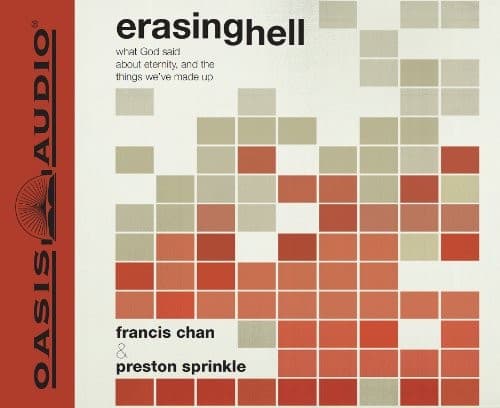
Erasing Hell
محو الجحيم
Effacer l'enfer
Editorial summary
This monograph represents a contemporary evangelical response to renewed debates about hell and eternal punishment within Protestant Christianity. The work emerges directly from controversies surrounding Rob Bell's Love Wins and similar texts that challenge traditional doctrines of eternal conscious torment. Sprinkle, writing with Francis Chan, attempts to provide a biblically grounded defense of classical evangelical teachings about hell while engaging seriously with universalist and annihilationist alternatives.
The authors employ a methodology that prioritizes biblical exegesis while maintaining pastoral sensitivity. Each chapter examines specific scriptural passages traditionally associated with hell, including Jesus' teachings in the Gospels, Pauline epistles, and apocalyptic literature. Sprinkle demonstrates particular expertise in analyzing Greek terminology and Jewish intertestamental literature, arguing that first-century Jewish concepts of judgment significantly inform New Testament passages. The work systematically addresses key interpretive questions: whether biblical language about destruction implies annihilation, how metaphorical descriptions of fire and darkness should be understood, and what eternal punishment means in scriptural context.
Against universalist interpretations, Sprinkle argues that scripture consistently teaches a final separation between the saved and unsaved. He critiques Bell and others for allowing emotional responses to overshadow textual evidence, though he acknowledges the genuine pastoral difficulties posed by traditional doctrine. Against annihilationism, he maintains that biblical language supports conscious eternal punishment rather than cessation of existence. However, the work avoids simplistic proof-texting, acknowledging interpretive complexities and areas where scripture remains less explicit than systematic theology might prefer.
The monograph's significance lies in its attempt to model charitable evangelical engagement with heterodox positions while maintaining doctrinal boundaries. Sprinkle combines academic rigor with accessible prose, making scholarly discussions available to lay readers. His treatment of Jewish apocalyptic literature provides valuable historical context often missing from popular-level discussions. The work illustrates how contemporary evangelical scholarship navigates between fundamentalist rigidity and progressive revisionism.
While defending traditional doctrine, Sprinkle emphasizes divine justice rather than vindictive punishment, arguing that hell reflects God's holiness and human moral responsibility. This represents a subtle but important shift in evangelical rhetoric, moving away from fear-based presentations toward theodicy-centered arguments. The monograph thus contributes to ongoing evangelical self-examination about how core doctrines should be articulated in contemporary contexts while remaining faithful to scriptural authority.
Argument formulations engaged
Sprinkle, Preston (2011). Erasing Hell. David C Cook.
@book{erasing-hell-2011,
  author    = {Sprinkle, Preston},
  title     = {Erasing Hell},
  year      = {2011},
  publisher = {David C Cook},
  url       = {https://god-database.com/en/works/erasing-hell-2011}
}