
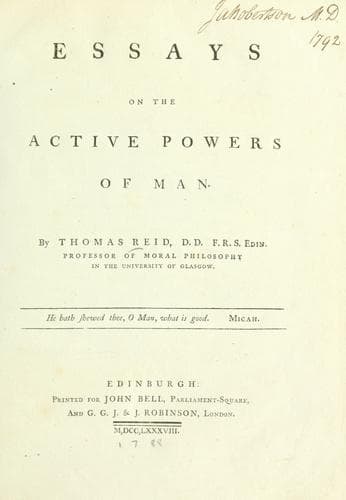
Essays on the Active Powers of Man
مقالات في القوى الفاعلة للإنسان
Essais sur les pouvoirs actifs de l'homme
Editorial summary
Thomas Reid's Essays on the Active Powers of Man represents a crucial intervention in eighteenth-century debates about human nature, moral agency, and divine design. This work complements his earlier Essays on the Intellectual Powers of Man by examining the volitional and moral faculties that Reid considers essential to understanding humanity's relationship to God. Writing against the skeptical currents of David Hume and the necessitarian philosophy of Joseph Priestley and others, Reid defends a robust conception of human agency that grounds both moral responsibility and natural theology.
Reid's common sense philosophy underpins his analysis of active powers, which he defines as the capacity to originate action through will. Against Humean skepticism about causation and personal identity, Reid argues that consciousness provides immediate and indubitable evidence of our power to act. This direct awareness of agency serves as the paradigm for understanding all causation, including divine causation. Reid contends that denying genuine active power in humans ultimately leads to atheism by making God's creative power unintelligible.
The work systematically examines conscience, moral perception, and duty, arguing that these faculties point toward divine design. Reid maintains that moral principles are self-evident truths perceived through a God-given moral sense, analogous to how mathematical truths are grasped by reason. This moral realism opposes both Humean sentimentalism and utilitarian reductions of ethics to pleasure and pain. For Reid, the universality and necessity of moral principles indicate their divine origin.
Reid's treatment of liberty proves particularly significant for natural theology. He argues that genuine freedom of will, incompatible with strict causal necessity, is presupposed by moral responsibility. This libertarian position supports belief in divine justice and providence while refuting materialist determinism. Reid explicitly connects human free agency to the imago Dei doctrine, suggesting that active power represents humanity's closest resemblance to divine creativity.
The Essays influenced subsequent Scottish philosophy and American moral thought, particularly at Princeton. Reid's arguments provided intellectual resources for resisting both deism and materialism while maintaining Enlightenment commitments to reason and empirical method. His integration of common sense epistemology with theistic metaphysics offered a middle path between enthusiasm and skepticism. The work remains relevant to contemporary discussions of free will, moral realism, and the argument from consciousness for theism.
Argument formulations engaged
Reid, Thomas (1788). Essays on the Active Powers of Man. Edinburgh University Press.
@book{essays-on-the-active-powers-of-man-1788,
  author    = {Reid, Thomas},
  title     = {Essays on the Active Powers of Man},
  year      = {1788},
  publisher = {Edinburgh University Press},
  url       = {https://god-database.com/en/works/essays-on-the-active-powers-of-man-1788}
}