
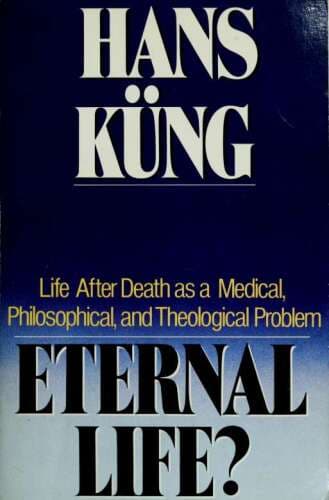
Eternal Life?: Life After Death as a Medical, Philosophical, and Theological Problem
الحياة الأبدية؟: الحياة بعد الموت كمشكلة طبية وفلسفية ولاهوتية
Vie éternelle ? : La vie après la mort comme problème médical, philosophique et théologique
Editorial summary
Hans Küng's "Eternal Life?: Life After Death as a Medical, Philosophical, and Theological Problem" presents a comprehensive interdisciplinary examination of human mortality and the possibility of life after death. Writing in 1984, Küng engages with the question of eternal life not merely as a theological doctrine but as a problem demanding serious attention from medical science, philosophy, and theology alike.
The work begins by confronting the modern medical understanding of death, acknowledging how advances in resuscitation technology and near-death experience research have complicated traditional definitions of death. Küng examines these phenomena critically, neither dismissing them as mere physiological artifacts nor accepting them as proof of an afterlife. He demonstrates how the medicalization of death in contemporary society has paradoxically both demystified dying and raised new questions about consciousness and human identity.
Philosophically, Küng engages with both classical and contemporary thinkers, from Plato and Aristotle through Kant and Hegel to twentieth-century existentialists. He analyzes how different philosophical traditions have conceptualized personal identity, temporal existence, and the possibility of survival beyond death. The work particularly addresses the challenge posed by materialist philosophy and scientific naturalism to traditional religious concepts of the soul and immortality.
Theologically, Küng develops a nuanced position that seeks to preserve the Christian hope of resurrection while taking seriously modern critical scholarship and scientific knowledge. He distinguishes between mythological representations and the essential content of belief in eternal life, arguing that faith in God necessarily implies trust in God's faithfulness beyond death. However, he rejects simplistic notions of immortality that ignore the reality of death or reduce eternal life to mere temporal continuation.
The monograph's significance lies in its methodological approach, which refuses to compartmentalize religious, scientific, and philosophical perspectives. Küng demonstrates that the question of life after death cannot be adequately addressed by any single discipline in isolation. His work challenges both religious fundamentalism that ignores scientific evidence and scientific reductionism that dismisses the existential and spiritual dimensions of human mortality. By maintaining creative tension between these perspectives, Küng opens space for intellectually honest dialogue about ultimate human destiny in the context of belief in God.
Argument formulations engaged
Related works
Kung, Hans (1984). Eternal Life?: Life After Death as a Medical, Philosophical, and Theological Problem.
@book{eternal-life-life-after-death-as-a-medic,
author = {Kung, Hans},
title = {Eternal Life?: Life After Death as a Medical, Philosophical, and Theological Problem},
year = {1984},
url = {https://god-database.com/en/works/eternal-life-life-after-death-as-a-medical-philosophical-and-theological-problem-1984}
}