
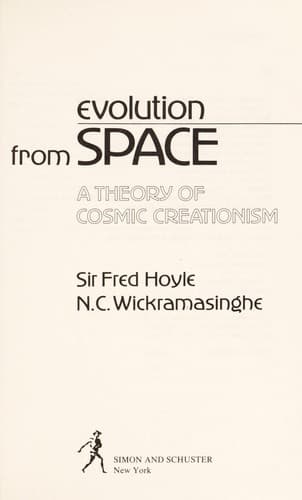
Evolution from Space.. A Theory of Cosmic Creationism
التطور من الفضاء.. نظرية في الخلق الكوني
L'évolution depuis l'espace.. Une théorie du créationnisme cosmique
The complexity and fine-tuning of biological life cannot be explained by terrestrial Darwinian evolution alone, and point instead toward a cosmic intelligence or creative agency operating at a universal scale.
Editorial summary
This monograph presents Hoyle's controversial theory that life on Earth originated from biological material dispersed throughout the cosmos, while simultaneously engaging fundamental questions about cosmic design and divine agency. Departing from conventional evolutionary biology, Hoyle argues that the complexity of living systems cannot be explained through terrestrial chemical evolution alone, proposing instead that genetic programs arrived from space via cometary bombardment and continue to drive evolutionary development.
Hoyle employs his expertise in astrophysics and mathematics to challenge neo-Darwinian orthodoxy, calculating probability thresholds that he claims render spontaneous biogenesis effectively impossible within Earth's timeframe. His methodology combines rigorous mathematical analysis with speculative cosmology, examining biochemical complexity through the lens of information theory and cosmic evolution. The work systematically critiques reductionist accounts of life's origin, particularly those promoted by molecular biologists who assume purely terrestrial mechanisms.
Central to Hoyle's argument is the claim that observed biological complexity requires a cosmic evolutionary process spanning billions of years across vast spatial scales. He contends that genetic information represents a form of cosmic programming that implies intelligent design, though he carefully avoids traditional religious language. This leads him to posit what he terms "cosmic intelligence" - a naturalistic yet purposive force operating through physical laws to generate and distribute life throughout the universe.
The monograph engages directly with contemporary debates in philosophy of science, particularly concerning reductionism, emergence, and the limits of methodological naturalism. Hoyle challenges both religious creationists and secular evolutionists, proposing a third way that acknowledges design while remaining within scientific discourse. His critique extends to the anthropic principle, which he reformulates to suggest that cosmic conditions not only permit life but actively generate and disseminate it.
The work's significance lies in its attempt to bridge scientific cosmology with design arguments, offering a sophisticated alternative to both biblical creationism and atheistic materialism. While Hoyle's panspermia hypothesis remains scientifically marginal, his philosophical challenge to origin-of-life research continues to influence debates about complexity, information, and purpose in nature. The monograph exemplifies how scientific dissent can open unexpected theological possibilities, suggesting that design arguments need not rely on supernatural intervention but might emerge from deeper understanding of cosmic processes themselves.
Structured analysis
Argument formulations engaged
Hoyle, Fred (1984). Evolution from Space.. A Theory of Cosmic Creationism.
@book{evolution-from-space-a-theory-of-cosmic-,
  author    = {Hoyle, Fred},
  title     = {Evolution from Space.. A Theory of Cosmic Creationism},
  year      = {1984},
  url       = {https://god-database.com/en/works/evolution-from-space-a-theory-of-cosmic-creationism}
}