
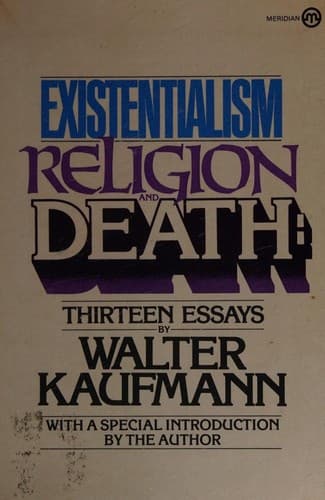
Existentialism, Religion, and Death: Thirteen Essays
الوجودية والدين والموت: ثلاث عشرة مقالة
Existentialisme, religion et mort : Treize essais
Editorial summary
This collection brings together Walter Kaufmann's sustained philosophical engagement with the intersection of existentialism, religious thought, and human mortality. Written between 1958 and 1975, these thirteen essays demonstrate Kaufmann's distinctive approach to existential philosophy, which emphasizes the confrontation with death as central to authentic human existence while maintaining a critical distance from traditional religious consolations.
Kaufmann develops his existentialist position through careful analysis of key figures including Kierkegaard, Nietzsche, Heidegger, and Sartre, arguing that authentic existentialism requires facing the reality of death without recourse to supernatural beliefs. His essay "Existentialism and Death" articulates the core thesis: that genuine philosophical reflection begins with acknowledging human finitude and mortality. This acknowledgment, Kaufmann contends, need not lead to despair but can ground a meaningful ethics based on honesty, courage, and creative self-realization.
The religious dimension of the collection emerges most forcefully in Kaufmann's critique of what he terms "pseudo-religious" responses to existential anxiety. In essays such as "The Faith of a Heretic" and "On Death and Lying," he argues that traditional theistic responses to mortality represent a form of bad faith that prevents authentic engagement with the human condition. Yet Kaufmann distinguishes between institutional religion, which he views as largely inauthentic, and certain forms of religious experience that acknowledge rather than evade existential realities.
Methodologically, Kaufmann combines philosophical analysis with literary interpretation and psychological insight. His approach draws on German philosophical traditions while maintaining accessibility for broader audiences. He positions himself against both nihilistic interpretations of existentialism and religious orthodoxies that promise escape from existential anxiety through faith.
The collection's significance lies in its articulation of a humanistic existentialism that neither requires religious belief nor collapses into nihilism. Kaufmann demonstrates how confronting mortality can lead to enhanced appreciation for human creativity, moral responsibility, and the pursuit of excellence. His work challenges both religious believers who seek comfort in afterlife doctrines and secular thinkers who avoid serious engagement with death's implications for human meaning. The essays collectively argue for a philosophical stance that embraces human finitude while affirming the possibility of creating meaningful existence without divine guarantees.
Argument formulations engaged
Related works
Kaufmann, Walter (1976). Existentialism, Religion, and Death: Thirteen Essays. New American Library.
@book{existentialism-religion-and-death-thirte,
  author    = {Kaufmann, Walter},
  title     = {Existentialism, Religion, and Death: Thirteen Essays},
  year      = {1976},
  publisher = {New American Library},
  url       = {https://god-database.com/en/works/existentialism-religion-and-death-thirteen-essays-1976}
}