
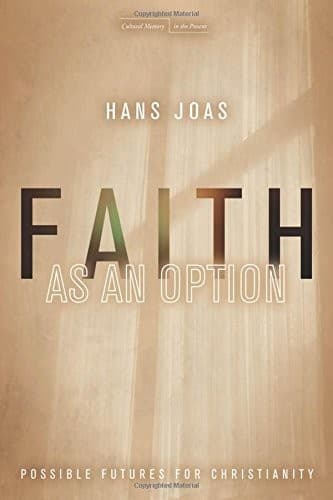
Faith as an Option
الإيمان كخيار
La foi comme option
Editorial summary
Hans Joas presents a sophisticated defense of religious faith as a legitimate existential option in contemporary secular societies. This work directly challenges the secularization thesis and its implicit assumption that religious belief represents an outdated or irrational worldview destined for extinction. Joas argues that faith remains not merely viable but intellectually defensible in modernity, offering a middle path between fundamentalist certainty and reductive secularism.
The monograph develops through careful engagement with classical pragmatism, particularly William James's notion of genuine options in belief formation. Joas extends Jamesian insights to demonstrate how religious commitment can emerge from profound experiences of self-transcendence, which he terms "experiences of the sacred." These transformative encounters resist reduction to psychological or sociological explanations while remaining accessible to phenomenological investigation. Against critics who dismiss religious experience as mere projection or wish-fulfillment, Joas argues that such experiences possess their own evidential weight and cannot be excluded a priori from rational consideration.
Methodologically, Joas employs a historicist approach that traces the contingent development of both religious traditions and secular worldviews. This historical consciousness reveals that secularism itself represents one option among others rather than the inevitable endpoint of cultural evolution. He particularly targets the presumption, common among secular intellectuals, that religious decline follows necessarily from modernization processes. Through detailed analysis of religious revivals and transformations, Joas demonstrates the ongoing creativity and adaptability of religious communities.
The work's most significant contribution lies in its reconfiguration of the faith-reason debate. Rather than opposing religious belief to rational inquiry, Joas shows how faith emerges from and responds to fundamental human experiences that demand interpretation. He develops a post-secular framework wherein believers and non-believers can engage in genuine dialogue without either party claiming epistemic superiority. This approach acknowledges the reasonable disagreement that characterizes pluralistic societies while maintaining that religious perspectives offer indispensable insights into human existence.
Joas ultimately defends what he calls "affirming genealogy" - a mode of understanding that recognizes the historical contingency of belief systems while remaining open to their truth claims. This position challenges both religious fundamentalism, which denies contingency, and militant atheism, which reduces religion to delusion. The monograph thus provides crucial theoretical resources for understanding religion's persistence and transformation in contemporary societies.
Argument formulations engaged
Joas, Hans (2014). Faith as an Option.
@book{faith-as-an-option-2014,
  author    = {Joas, Hans},
  title     = {Faith as an Option},
  year      = {2014},
  url       = {https://god-database.com/en/works/faith-as-an-option-2014}
}