
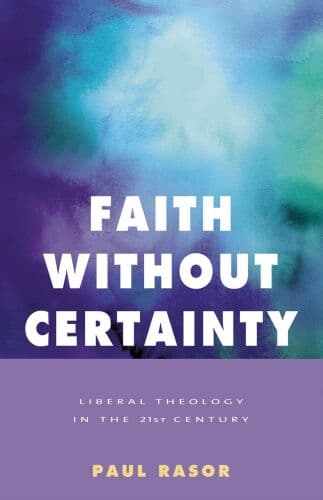
Faith without Certainty
الإيمان بلا يقين
La foi sans certitude
Religious faith can be rationally and morally permissible even in the absence of conclusive evidence or certainty, provided it is held with appropriate epistemic humility and openness.
Editorial summary
John Bishop's Faith without Certainty presents a sophisticated philosophical defense of religious faith that navigates between dogmatic certainty and complete skepticism. Writing within the Christian analytic tradition, Bishop develops an account of rational religious commitment that acknowledges the absence of conclusive evidence for theistic beliefs while maintaining that faith can nevertheless be intellectually respectable and practically necessary.
The work directly challenges both evidentialist critics who demand proof for religious belief and reformed epistemologists who claim that theistic belief can be properly basic without evidence. Against evidentialists, Bishop argues that the demand for certainty before commitment reflects an unrealistic standard that would paralyze practical reasoning in many domains of life. Against reformed epistemology, particularly as developed by Alvin Plantinga, Bishop contends that the appeal to proper basicality fails to adequately address the genuine epistemic ambiguity surrounding religious claims.
Bishop's central contribution lies in his development of a "doxastic venture" model of faith. This approach acknowledges that religious believers make cognitive commitments that exceed what their evidence strictly warrants, but argues that such ventures can be rational when practically necessary and morally permissible. Drawing on William James's will-to-believe doctrine while subjecting it to rigorous analytical scrutiny, Bishop constructs a framework where faith involves taking cognitive risks that are neither arbitrary leaps nor evidentially compelled conclusions.
The philosophical method employed throughout combines careful conceptual analysis with attention to the phenomenology of religious belief. Bishop examines how actual believers navigate uncertainty, showing that faith typically involves complex attitudes toward doubt rather than simple denial of it. His argument engages extensively with contemporary epistemology, particularly debates about pragmatic encroachment on justification and the ethics of belief.
The work's significance for the God debate lies in its articulation of a middle path that takes seriously both the intellectual challenges to religious belief and the lived reality of faith communities. Bishop demonstrates that one need not choose between intellectual integrity and religious commitment, provided one acknowledges the tentative and venture-like character of faith. This position offers resources for religious believers who experience doubt while maintaining that their faith remains rational, and challenges atheistic critiques that assume religious belief requires either conclusive evidence or intellectual dishonesty.
Structured analysis
Argument formulations engaged
Bishop, John Faith without Certainty. Skinner House Books.
@book{faith-without-certainty,
  author    = {Bishop, John},
  title     = {Faith without Certainty},
  year      = {n.d.},
  publisher = {Skinner House Books},
  url       = {https://god-database.com/en/works/faith-without-certainty}
}