
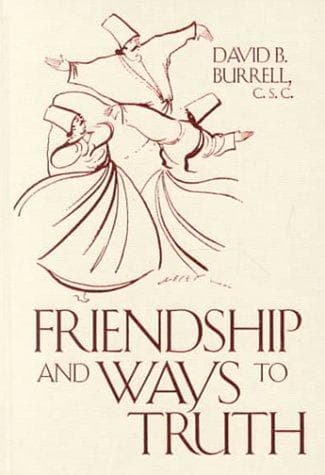
Friendship and Ways to Truth
الصداقة وطرق الحقيقة
Amitié et voies vers la vérité
Editorial summary
This monograph examines how interpersonal friendships serve as a crucial pathway for understanding religious truth, challenging conventional epistemological approaches that privilege detached rational inquiry. Burrell argues that the experiential dimension of friendship provides unique access to truths about divine reality that remain inaccessible through purely theoretical investigation. Drawing extensively on Aquinas, Augustine, and contemporary philosophy of religion, the work develops a relational epistemology that positions friendship as both a metaphor for and means of approaching the divine-human relationship.
The book engages critically with the Enlightenment tradition's emphasis on autonomous reason as the primary route to religious knowledge. Against figures like Descartes and Kant who sought to establish religious truth through individual rational reflection, Burrell contends that friendship's interpersonal dynamics mirror and illuminate the participatory nature of religious understanding. He argues that just as human friendships require trust, vulnerability, and gradual mutual disclosure, so too does authentic knowledge of God emerge through relational engagement rather than detached analysis.
Burrell's methodology combines historical retrieval of medieval insights with contemporary philosophical analysis. He demonstrates how Aquinas's notion of connaturality—a kind of affective attunement that comes through love—provides resources for understanding how friendship shapes knowledge. The work also engages Islamic and Jewish philosophical traditions, particularly Al-Ghazali and Maimonides, showing how these thinkers similarly recognized friendship's epistemological significance for theological understanding.
The monograph's central contribution lies in its challenge to both rationalist natural theology and fideistic approaches that divorce faith from reason. Burrell proposes instead that friendship represents a middle way, where rational reflection and personal commitment intertwine. This position has significant implications for debates about religious epistemology, suggesting that arguments about God's existence cannot be adequately assessed apart from the relational contexts in which religious beliefs are formed and sustained.
The work particularly advances discussions about the role of testimony, trust, and communal practice in religious knowledge. By showing how friendship involves a kind of "participatory knowing" that transcends subject-object dualism, Burrell offers resources for understanding religious faith as neither purely subjective experience nor detached intellectual assent, but as a form of relational wisdom. His argument implies that philosophical debates about God that neglect the interpersonal dimensions of religious life fail to engage the phenomenon adequately.
Argument formulations engaged
Burrell, David B. (2000). Friendship and Ways to Truth. University of Notre Dame Press.
@book{friendship-and-ways-to-truth-2000,
  author    = {Burrell, David B.},
  title     = {Friendship and Ways to Truth},
  year      = {2000},
  publisher = {University of Notre Dame Press},
  url       = {https://god-database.com/en/works/friendship-and-ways-to-truth-2000}
}