
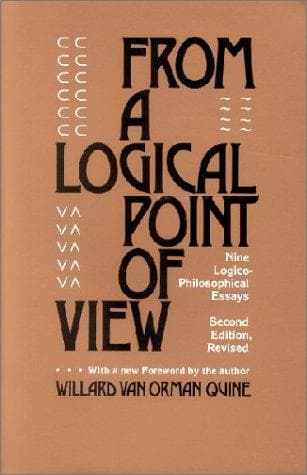
From a Logical Point of View
من وجهة نظر منطقية
D'un point de vue logique
Editorial summary
Willard Van Orman Quine's From a Logical Point of View represents a watershed moment in twentieth-century analytic philosophy, fundamentally reshaping debates about ontology, meaning, and the nature of philosophical inquiry itself. While not explicitly focused on theological questions, this collection of essays profoundly influences how philosophers approach arguments about God's existence and religious language.
The work's most significant contribution lies in Quine's devastating critique of the analytic-synthetic distinction, particularly in "Two Dogmas of Empiricism." By dismantling the traditional separation between truths of meaning and truths of fact, Quine undermines a central pillar of both rationalist theology and logical positivist rejections of religious discourse. His argument suggests that even seemingly necessary truths, including those invoked in ontological arguments for God's existence, remain revisable in light of experience. This position challenges both classical theistic proofs that rely on supposedly analytic premises and atheistic arguments that dismiss religious claims as meaningless.
Quine's naturalized epistemology, developed throughout these essays, proposes that philosophy should be continuous with empirical science rather than occupying a privileged foundational position. This approach has profound implications for natural theology and religious epistemology. By rejecting first philosophy and emphasizing the web-like structure of belief, Quine's framework suggests that religious beliefs cannot be evaluated in isolation but must be assessed as part of our total theory of the world.
The celebrated essay "On What There Is" introduces Quine's criterion of ontological commitment: to be is to be the value of a variable in our best scientific theories. This austere approach to existence claims provides a powerful tool for evaluating theological assertions while avoiding metaphysical excess. Quine's method suggests that arguments about God's existence must be reframed in terms of whether our most successful explanatory theories require divine entities as values for their variables.
The collection's influence extends beyond direct theological applications. Quine's holism about confirmation and his thesis of the indeterminacy of translation raise fundamental questions about religious language and cross-cultural understanding of divine concepts. His pragmatic approach to ontology, emphasizing simplicity and explanatory power, establishes new ground rules for debates between naturalists and theists about what entities we should admit into our worldview.
Argument formulations engaged
Quine, W. V. O. (1953). From a Logical Point of View. Harvard University Press.
@book{from-a-logical-point-of-view-1953,
  author    = {Quine, W. V. O.},
  title     = {From a Logical Point of View},
  year      = {1953},
  publisher = {Harvard University Press},
  url       = {https://god-database.com/en/works/from-a-logical-point-of-view-1953}
}