
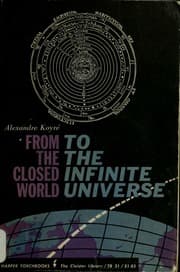
From the Closed World to the Infinite Universe
من العالم المغلق إلى الكون اللامحدود
Du monde clos à l'univers infini
Editorial summary
Alexandre Koyré's seminal study traces the profound transformation of Western cosmology from medieval finitude to modern infinity, a shift that fundamentally altered humanity's understanding of its place in relation to the divine. The work examines how the replacement of the closed, hierarchical cosmos of Aristotelian-Christian thought with an infinite, homogeneous universe reshaped theological and philosophical discourse about God's nature and relationship to creation.
Koyré demonstrates that medieval cosmology, with its finite spheres and qualitative distinctions between celestial and terrestrial realms, supported a particular vision of divine order. This closed world picture positioned God as transcendent architect of a purposeful, comprehensible structure where humanity occupied a central, if lowly, position. The book meticulously analyzes how this framework began dissolving in the fifteenth and sixteenth centuries through the work of Nicholas of Cusa, who first posited an infinite universe that challenged traditional boundaries between Creator and creation.
The study's core contribution lies in showing how the scientific revolution's cosmological innovations forced radical theological reconsiderations. Through detailed examination of Copernicus, Bruno, Galileo, Descartes, and Newton, Koyré reveals how the infinite universe concept transformed God from the intimate governor of a closed system into either an infinitely distant deity or a pantheistic presence pervading boundless space. The work particularly emphasizes how Giordano Bruno's vision of infinite worlds challenged Christian uniqueness claims and divine providence concepts.
Koyré's intellectual historical method illuminates the reciprocal relationship between scientific and theological thought. He demonstrates that cosmological shifts were never purely empirical matters but involved metaphysical commitments about divine nature and action. The infinite universe posed unprecedented problems: How could God maintain providential care over infinite space? What meaning could human existence claim in boundless vastness? These questions, Koyré shows, drove both scientific investigation and theological innovation.
The monograph's lasting significance lies in revealing how spatial concepts shape religious imagination. By documenting the movement from closed to infinite cosmos, Koyré exposes the contingency of theological formulations dependent on cosmological assumptions. His analysis suggests that modern difficulties in conceiving divine presence and action stem partly from inheriting an infinite universe framework that early modern thinkers struggled to reconcile with traditional theism. The work remains essential for understanding how scientific cosmology conditions possibilities for theological discourse.
Argument formulations engaged
Alexandre, Koyre‚ (1957). From the Closed World to the Infinite Universe.
@book{from-the-closed-world-to-the-infinite-un,
  author    = {Alexandre, Koyre‚},
  title     = {From the Closed World to the Infinite Universe},
  year      = {1957},
  url       = {https://god-database.com/en/works/from-the-closed-world-to-the-infinite-universe-1957}
}