
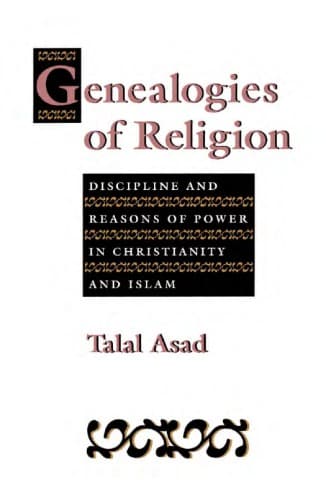
Genealogies of Religion: Discipline and Reasons of Power in Christianity and Islam
أنساب الدين: الانضباط ومبررات القوة في المسيحية والإسلام
Généalogies de la religion : Discipline et raisons du pouvoir dans le christianisme et l'islam
Editorial summary
Talal Asad's Genealogies of Religion challenges conventional assumptions about religion as a transhistorical, universal category by examining how the modern concept of religion emerged through specific historical processes in Christian Europe. The work constitutes a significant intervention in religious studies and anthropology, arguing that what scholars take to be religion in general actually reflects particular Western Christian formations of power, discipline, and secular rationality.
Asad employs a genealogical method derived from Michel Foucault to trace how medieval Christian practices of discipline and embodied knowledge transformed into modern notions of religion as private belief. He demonstrates that the category of religion itself emerged through colonial encounters and the formation of the secular state, which required religion to be defined as a discrete sphere separate from politics, law, and science. This genealogical approach reveals that supposedly neutral scholarly definitions of religion carry implicit theological and political assumptions rooted in Christian history.
The monograph's central chapters examine how anthropologists have constructed religion as an object of study, showing how definitions that emphasize belief, meaning, and symbolism reflect Protestant Christian emphases while obscuring the role of power, discipline, and embodiment in religious traditions. Asad's analysis of medieval Christianity demonstrates how monastic disciplines shaped subjects through bodily practices rather than through adherence to propositions or symbols. His comparative work on Islam shows how applying Western categories of religion distorts Islamic traditions, which do not separate religious from political authority in the manner presumed by secular modernity.
While not directly addressing arguments for or against God's existence, Asad's work profoundly impacts how scholars approach the God question by destabilizing the very category through which such debates occur. His genealogical critique suggests that modern discussions about theism and atheism operate within a discursive framework shaped by Christian secularism, making genuinely cross-cultural dialogue about ultimate reality difficult. The work implies that both theistic and atheistic positions may share unexamined assumptions about what constitutes religion and its proper relationship to reason, politics, and truth.
Asad's contribution reframes debates about God by showing how the conceptual apparatus used in such discussions emerges from specific historical configurations of power rather than universal reason. This genealogical perspective opens space for recognizing alternative ways of conceiving divine-human relationships that do not conform to modern Western categories of religion and secularity.
Argument formulations engaged
Related works
Asad, Talal (1993). Genealogies of Religion: Discipline and Reasons of Power in Christianity and Islam.
@book{genealogies-of-religion-discipline-and-r,
  author    = {Asad, Talal},
  title     = {Genealogies of Religion: Discipline and Reasons of Power in Christianity and Islam},
  year      = {1993},
  url       = {https://god-database.com/en/works/genealogies-of-religion-discipline-and-reasons-of-power-in-christianity-and-islam-1993}
}