
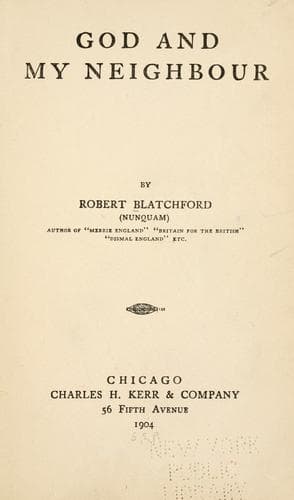
God and My Neighbour
الله وجاري
Dieu et mon prochain
Editorial summary
This work represents one of the most influential popular atheistic texts of early twentieth-century Britain. Robert Blatchford, a socialist journalist and editor of The Clarion newspaper, presents a systematic critique of Christian theism aimed at working-class readers. The book emerges from a series of articles originally published in his newspaper, responding to clerical critics who had attacked his socialist politics as incompatible with Christianity.
Blatchford structures his argument as a direct address to ordinary believers, employing accessible language and everyday examples to dismantle what he considers the logical inconsistencies of Christian doctrine. He challenges the existence of God through several interconnected arguments. First, he contests the problem of evil, arguing that an omnipotent and benevolent deity cannot coexist with human suffering and natural disasters. Second, he attacks the reliability of biblical testimony, highlighting contradictions within scripture and questioning the historical accuracy of miraculous claims. Third, he advances a deterministic view of human behavior that undermines traditional notions of free will and moral responsibility central to Christian theology.
The work's significance lies not in philosophical sophistication but in its rhetorical effectiveness and social impact. Blatchford combines rationalist critiques familiar from earlier freethinkers with appeals to working-class experience and socialist political consciousness. He argues that Christianity perpetuates social injustice by encouraging passive acceptance of poverty and promising rewards in an imaginary afterlife. This fusion of atheistic argument with socialist politics distinguishes his approach from more abstract philosophical treatments of the God question.
Methodologically, Blatchford relies on common-sense reasoning and empirical observation rather than formal philosophical analysis. He frequently invokes scientific discoveries, particularly in geology and biology, to challenge biblical chronology and divine creation. His polemical style, while lacking academic rigor, proves highly effective in reaching his intended audience. The book reportedly converted thousands to atheism and prompted numerous published responses from clergy and Christian apologists.
The work's lasting contribution lies in demonstrating how the God debate intersects with questions of social justice and political ideology. Blatchford shows that arguments about divine existence cannot be separated from their social contexts and consequences. His populist approach to atheistic argument establishes a template for subsequent writers seeking to bring philosophical skepticism to mass audiences, making him a pivotal figure in the democratization of religious criticism in modern Britain.
Argument formulations engaged
Related works
Blatchford, Robert (1903). God and My Neighbour. Blackmask Online.
@book{god-and-my-neighbour-1903,
  author    = {Blatchford, Robert},
  title     = {God and My Neighbour},
  year      = {1903},
  publisher = {Blackmask Online},
  url       = {https://god-database.com/en/works/god-and-my-neighbour-1903}
}