
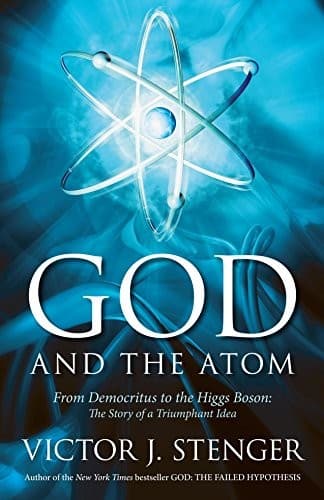
God and the Atom
الله والذرة
Dieu et l'atome
Modern atomic and particle physics, far from supporting theistic conclusions, provides a naturalistic account of matter and cosmos that leaves no evidential room for a creator God.
Editorial summary
Victor J. Stenger's "God and the Atom" (2013) presents a comprehensive case against theistic interpretations of modern physics and cosmology, tracing the philosophical implications of atomism from ancient Greece to contemporary particle physics. The work systematically examines how the atomistic worldview, which posits that reality consists fundamentally of particles and void, undermines traditional arguments for divine existence.
Stenger, a physicist writing within the secular-naturalist tradition, employs a philosophy of science methodology to demonstrate that the success of reductionist physics eliminates the need for supernatural explanations. The monograph's central thesis holds that the atomistic framework, refined through centuries of scientific discovery, provides sufficient explanatory power for phenomena previously attributed to divine action. By examining the historical development from Democritus through quantum mechanics, Stenger argues that each advance in understanding matter's fundamental nature has progressively narrowed the explanatory gaps where God might reside.
The work directly engages three major theistic argument families. Against cosmological arguments, Stenger contends that quantum mechanics demonstrates how something can arise from nothing without divine intervention, citing quantum fluctuations and virtual particles. Regarding design arguments, he marshals evidence from particle physics showing that apparent order emerges naturally from simple laws governing atomic interactions, requiring no designer. Most substantially, Stenger confronts fine-tuning arguments by demonstrating that the supposed fine-tuning of physical constants reflects human selection bias rather than divine calibration. He argues that alternative universes with different constants could support complexity through mechanisms we cannot envision.
The monograph's significance lies in its synthesis of historical perspective with cutting-edge physics to challenge contemporary natural theology. Unlike many atheistic critiques focusing solely on logical analysis, Stenger grounds his arguments in empirical findings from particle physics, cosmology, and quantum mechanics. His approach directly counters physicists and philosophers who interpret modern physics as supporting theism, particularly those emphasizing quantum indeterminacy or cosmological fine-tuning as evidence for God.
Stenger's contribution advances the atheistic position by demonstrating how the atomistic worldview, validated by modern physics, provides a complete naturalistic framework that renders supernatural explanations superfluous. The work represents a crucial intervention in debates about whether contemporary physics supports or undermines religious belief.
Structured analysis
Argument formulations engaged
Related works
Stenger, Victor J. (2013). God and the Atom. Prometheus Books.
@book{god-and-the-atom,
  author    = {Stenger, Victor J.},
  title     = {God and the Atom},
  year      = {2013},
  publisher = {Prometheus Books},
  url       = {https://god-database.com/en/works/god-and-the-atom}
}