
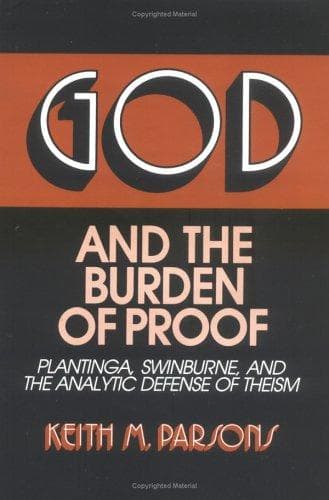
God and the Burden of Proof
الله وعبء الإثبات
Dieu et le fardeau de la preuve
Editorial summary
Parsons develops a systematic critique of theistic arguments, challenging the widespread assumption that atheism bears the burden of proof in debates about God's existence. His central thesis holds that theists, as proponents of existential claims, must provide adequate justification for belief, while atheists need only demonstrate the insufficiency of theistic evidence.
The work unfolds through careful analysis of classical and contemporary arguments for God's existence. Parsons examines ontological arguments from Anselm to Plantinga, cosmological arguments including both traditional formulations and modern versions like the kalam argument, and design arguments ranging from Paley's watchmaker to fine-tuning proposals. His method combines logical analysis with empirical considerations, demonstrating how each argument fails to establish its conclusion either through formal fallacies or questionable premises.
Parsons pays particular attention to Reformed epistemology and its claim that belief in God constitutes properly basic knowledge requiring no evidence. He argues that this position undermines rational discourse and opens the door to epistemic relativism. Against Plantinga's notion of warranted Christian belief, Parsons maintains that religious experiences lack the intersubjective verifiability necessary for knowledge claims.
The author situates his critique within broader epistemological debates about evidence, rationality, and justified belief. He draws on Humean skepticism about miracles and causation while engaging contemporary philosophers like Swinburne, Craig, and Alston. Parsons argues that naturalistic explanations consistently prove more parsimonious and empirically adequate than theistic alternatives, particularly regarding cosmic origins and apparent design.
Significantly, Parsons addresses the presumption of atheism debate initiated by Flew, defending a moderate position that distinguishes between psychological atheism (mere absence of belief) and philosophical atheism (justified disbelief based on examined evidence). He contends that while the burden of proof rests with theists, atheists strengthen their position by demonstrating specific failures in theistic argumentation.
The monograph's importance lies in its comprehensive treatment of epistemic issues surrounding God-belief. Parsons shifts focus from metaphysical speculation to methodological questions about evidence assessment and rational justification. His work challenges both philosophers of religion who assume theism's intellectual respectability and popular apologists who claim atheism requires faith. By establishing atheism as the epistemically default position pending adequate theistic evidence, Parsons provides a framework for evaluating religious claims that remains influential in contemporary debates about rationality and religious belief.
Argument formulations engaged
Related works
Parsons, Keith (1989). God and the Burden of Proof. Prometheus Books.
@book{god-and-the-burden-of-proof-1989,
  author    = {Parsons, Keith},
  title     = {God and the Burden of Proof},
  year      = {1989},
  publisher = {Prometheus Books},
  url       = {https://god-database.com/en/works/god-and-the-burden-of-proof-1989}
}