
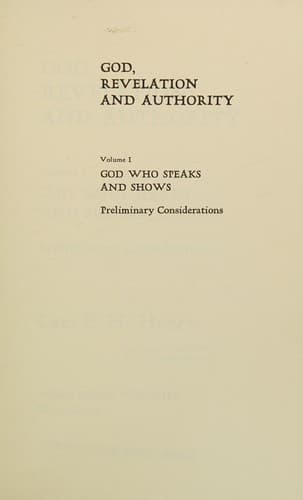
God, Revelation and Authority
الله والوحي والسلطة
Dieu, révélation et autorité
Editorial summary
This six-volume systematic theology represents one of the most comprehensive evangelical treatments of divine revelation and theological epistemology in the twentieth century. Henry constructs a rigorous defense of propositional revelation and biblical inerrancy while engaging critically with modern philosophical and theological challenges to traditional Christian theism.
The work's central thesis maintains that the self-revealing God of biblical Christianity provides the only adequate foundation for truth, meaning, and moral order. Henry argues that divine revelation comes primarily through intelligible verbal communication, rejecting neo-orthodox emphases on personal encounter divorced from cognitive content. Against existentialist and dialectical theologies, he insists that God's self-disclosure involves communicable truths about divine nature and purposes that can be rationally apprehended and systematically articulated.
Henry develops his argument through sustained interaction with contemporary philosophy, particularly logical positivism, linguistic analysis, and various forms of relativism. He contends that secular epistemologies inevitably collapse into skepticism or nihilism when divorced from theistic foundations. The work extensively critiques Barthian theology for severing revelation from rational propositions, arguing this approach undermines the possibility of genuine theological knowledge.
The methodology combines philosophical analysis with biblical exegesis, drawing on Gordon Clark's presuppositionalism while maintaining broader evangelical commitments. Henry examines competing worldviews to demonstrate their internal inconsistencies, arguing that only Christian theism provides coherent answers to fundamental questions about reality, knowledge, and ethics. He particularly emphasizes the role of language in divine-human communication, defending the possibility of univocal predication about God against analogical theories.
The volumes address numerous specific debates within evangelical theology, including the relationship between general and special revelation, the nature of biblical inspiration, and the proper understanding of religious language. Henry engages liberal Protestant thought, process theology, and secular philosophy with equal vigor, positioning evangelical Christianity as intellectually credible within academic discourse.
This work significantly shaped late twentieth-century evangelical theology, particularly in its emphasis on rational apologetics and propositional truth. Henry's insistence on the cognitive dimension of revelation influenced subsequent evangelical engagement with postmodernism and religious pluralism. The comprehensive scope and philosophical sophistication established new standards for evangelical systematic theology, though critics question whether his rationalistic approach adequately addresses the personal and transformative dimensions of religious faith.
Argument formulations engaged
Henry, Carl F. H. (1976). God, Revelation and Authority.
@book{god-revelation-and-authority-1976,
  author    = {Henry, Carl F. H.},
  title     = {God, Revelation and Authority},
  year      = {1976},
  url       = {https://god-database.com/en/works/god-revelation-and-authority-1976}
}