
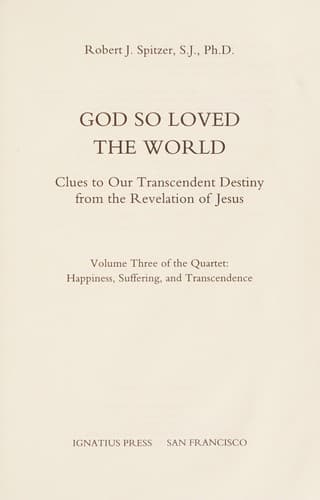
God So Loved the World: Clues to Our Transcendent Destiny from the Revelation of Jesus
الله أحب العالم هكذا: دلائل مصيرنا المتسامي من وحي يسوع
Dieu a tant aimé le monde : Indices de notre destinée transcendante à partir de la révélation de Jésus
Editorial summary
In "God So Loved the World," Robert J. Spitzer presents a comprehensive theological argument for God's existence and humanity's transcendent destiny through systematic analysis of Jesus Christ's revelation. The work synthesizes philosophical reasoning, scientific evidence, and biblical scholarship to construct a multi-faceted case for Christian theism while addressing contemporary skeptical challenges.
Spitzer structures his argument around three interconnected dimensions of evidence. First, he examines what he terms the "transcendental desires" inherent in human consciousness—the universal yearnings for perfect truth, love, justice, beauty, and home that point beyond material existence. These desires, he contends, cannot be explained by evolutionary processes alone but require a transcendent source and fulfillment. Second, he analyzes the historical evidence for Jesus's resurrection, engaging critically with skeptical historians while defending the reliability of Gospel accounts and early Christian testimony. Third, he explores how Jesus's teachings about love, suffering, and redemption reveal divine purposes that correspond to humanity's deepest existential questions.
The work particularly emphasizes the convergence between contemporary scientific discoveries and Christian revelation. Spitzer, drawing on his background in physics and philosophy, argues that findings in cosmology, quantum mechanics, and consciousness studies support rather than undermine belief in a loving Creator. He engages directly with materialist philosophers and scientists who claim that science has eliminated the need for God, demonstrating how their arguments often rely on unexamined metaphysical assumptions.
Methodologically, Spitzer employs what he calls "convergent philosophical argumentation," bringing together insights from natural theology, phenomenology, historical criticism, and systematic theology. This interdisciplinary approach aims to show that multiple independent lines of evidence point toward the same conclusion: that human beings are created for eternal communion with a God whose love is revealed definitively in Jesus Christ.
The monograph's significance lies in its ambitious attempt to bridge the gap between academic theology and popular apologetics. While maintaining scholarly rigor, Spitzer addresses the existential concerns of contemporary seekers, particularly those influenced by scientific materialism or religious pluralism. His integration of traditional Catholic theology with modern scientific and philosophical developments offers a sophisticated response to the "new atheism" while providing believers with intellectually robust foundations for faith. The work thus contributes to ongoing debates about the relationship between faith and reason, the interpretation of religious experience, and the ultimate meaning of human existence.
Argument formulations engaged
Spitzer, Robert J. (2016). God So Loved the World: Clues to Our Transcendent Destiny from the Revelation of Jesus. Ignatius Press.
@book{god-so-loved-the-world-clues-to-our-tran,
  author    = {Spitzer, Robert J.},
  title     = {God So Loved the World: Clues to Our Transcendent Destiny from the Revelation of Jesus},
  year      = {2016},
  publisher = {Ignatius Press},
  url       = {https://god-database.com/en/works/god-so-loved-the-world-clues-to-our-transcendent-destiny-from-the-revelation-of-jesus-2016}
}