
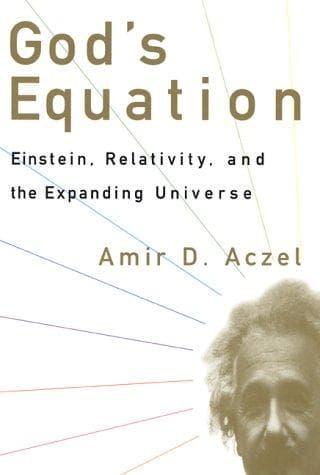
God's Equation.. Einstein, relativity and the expanding universe
معادلة الله.. أينشتاين والنسبية والكون المتمدد
L'Équation de Dieu.. Einstein, la relativité et l'univers en expansion
Einstein's cosmological equation and the discovery of an expanding universe open a space of philosophical and theological reflection on the origin and structure of the cosmos that neither pure science nor pure theology can close alone.
Editorial summary
This work examines the theological implications of Einstein's cosmological theories, particularly focusing on how general relativity and the discovery of universal expansion intersect with questions about divine design. Aczel traces the historical development of Einstein's field equations and their subsequent interpretation by physicists and theologians, demonstrating how scientific discoveries in cosmology have repeatedly reignited debates about God's existence and role in creation.
The author employs a philosophy of science approach to analyze how Einstein's famous cosmological constant, initially introduced to maintain a static universe model and later abandoned, paradoxically gained new relevance with evidence for cosmic acceleration. Aczel situates this scientific narrative within broader intellectual debates about whether the universe's mathematical elegance and fine-tuning point toward divine intelligence. He examines Einstein's own complex relationship with religious concepts, distinguishing between the physicist's rejection of a personal God and his embrace of Spinozist pantheism, while showing how subsequent thinkers have interpreted cosmological findings through various theological lenses.
Central to the work is an exploration of how modern cosmology engages with classical cosmological arguments for God's existence. Aczel demonstrates that discoveries about the universe's expansion, its apparent beginning in a singularity, and the precise calibration of physical constants have given new life to design arguments that seemed obsolete in the mechanistic worldview of classical physics. He analyzes how different scientists and philosophers have responded to these findings, from those who see them as evidence for divine action to those who invoke multiverse theories or anthropic principles to explain apparent design without recourse to God.
The text carefully examines how the fine-tuning argument has evolved in light of cosmological discoveries, particularly the narrow range of values that fundamental constants must possess for the universe to support complex structures and life. Aczel presents various perspectives on whether this fine-tuning constitutes evidence for design or merely reflects observational selection effects. Throughout, he maintains a dialogical stance, presenting competing interpretations while demonstrating how Einstein's equations continue to frame contemporary discussions about ultimate reality and divine action. The work contributes to understanding how scientific cosmology and natural theology remain in productive, if contested, dialogue in contemporary thought.
Structured analysis
Argument formulations engaged
Aczel, Amir D. (2000). God's Equation.. Einstein, relativity and the expanding universe.
@book{gods-equation-einstein-relativity-and-th,
  author    = {Aczel, Amir D.},
  title     = {God's Equation.. Einstein, relativity and the expanding universe},
  year      = {2000},
  url       = {https://god-database.com/en/works/gods-equation-einstein-relativity-and-the-expanding-universe}
}