
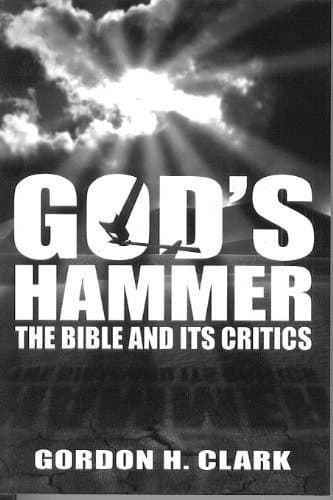
God's Hammer: The Bible and Its Critics
مطرقة الله: الكتاب المقدس ونقاده
Le marteau de Dieu : La Bible et ses critiques
Editorial summary
This monograph presents a vigorous defense of biblical authority against modern critical scholarship, employing presuppositionalist methodology to argue for Scripture's divine inspiration and inerrancy. Clark contends that biblical criticism rests on faulty philosophical foundations that inevitably lead to skepticism about religious knowledge. He maintains that only by presupposing the Bible as God's infallible revelation can one arrive at coherent truth claims about reality.
The work systematically examines and refutes various schools of biblical criticism, including source criticism, form criticism, and redaction criticism. Clark argues these methodologies operate from naturalistic assumptions that preclude divine authorship from the outset. He particularly targets the documentary hypothesis regarding Pentateuchal authorship, asserting that its proponents rely on circular reasoning and arbitrary linguistic analysis. Against scholars who view Scripture as culturally conditioned human testimony about religious experience, Clark insists the Bible constitutes propositional revelation directly from God.
Clark's epistemological framework proves central to his argument. He contends that all knowledge systems require unprovable starting points, and Christianity's axiom—that Scripture is God's word—provides the only foundation for certain knowledge. This presuppositionalist approach leads him to reject evidentialist apologetics that attempt to prove God's existence through empirical or rational arguments. Instead, he maintains that belief in God and acceptance of biblical authority stand or fall together as a unified worldview.
The monograph engages extensively with contemporary biblical scholars and theologians, including Rudolf Bultmann, Julius Wellhausen, and various neo-orthodox thinkers. Clark charges them with compromising biblical authority through accommodation to modern scientific and philosophical prejudices. He argues their critical methods dissolve the text's meaning into subjective interpretation, ultimately destroying any basis for theological truth claims.
This work contributes to the God debate by articulating a Reformed Protestant position that grounds theistic belief entirely in scriptural revelation. Clark's uncompromising stance challenges both secular critics who dismiss biblical claims and religious moderates who seek middle ground between traditional faith and modern scholarship. His argument that rational discourse about God requires accepting divinely revealed premises represents a significant strand in twentieth-century evangelical thought, influencing subsequent debates about religious epistemology and the relationship between faith and reason.
Argument formulations engaged
Clark, Gordon H. (1982). God's Hammer: The Bible and Its Critics. The Trinity Foundation.
@book{gods-hammer-the-bible-and-its-critics-19,
  author    = {Clark, Gordon H.},
  title     = {God's Hammer: The Bible and Its Critics},
  year      = {1982},
  publisher = {The Trinity Foundation},
  url       = {https://god-database.com/en/works/gods-hammer-the-bible-and-its-critics-1982}
}