
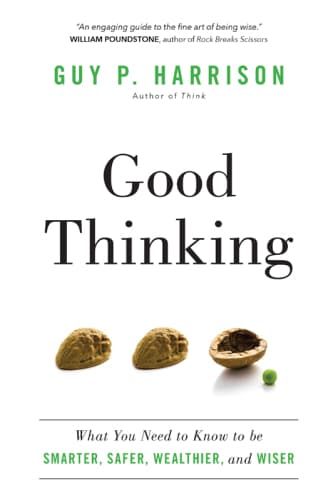
Good Thinking: What You Need to Know to Be Smarter, Safer, Wealthier, and Wiser
التفكير الجيد: ما تحتاج معرفته لتكون أذكى وأكثر أماناً وثراءً وحكمة
Bien penser : Ce que vous devez savoir pour être plus intelligent, plus sûr, plus riche et plus sage
Editorial summary
Guy P. Harrison's Good Thinking examines the relationship between critical thinking skills and belief formation, with particular attention to how cognitive biases shape religious and supernatural beliefs. While ostensibly a general guide to improved reasoning across various life domains, Harrison devotes substantial attention to analyzing why people maintain beliefs in gods, miracles, and supernatural phenomena despite lack of empirical evidence. The work positions itself within the broader skeptical movement, advocating for scientific rationalism as the most reliable path to truth.
Harrison employs a pedagogical approach that combines cognitive psychology research with practical examples drawn from contemporary culture. He systematically catalogs common reasoning errors—confirmation bias, pattern recognition gone awry, memory distortions, and emotional reasoning—demonstrating how these mental shortcuts that served evolutionary purposes now lead people toward unfounded beliefs. The author particularly emphasizes how these cognitive tendencies make humans susceptible to religious claims, arguing that supernatural beliefs persist not because they are true but because they exploit predictable flaws in human cognition.
The work engages primarily with popular religious apologetics and New Age spirituality rather than sophisticated theological arguments. Harrison critiques the special pleading often afforded to religious claims, arguing that beliefs about gods should be subject to the same evidentiary standards applied to any other domain of knowledge. He challenges the notion that faith represents a legitimate alternative epistemology, characterizing it instead as an abandonment of critical thinking. Throughout, he maintains that atheism or at minimum strong skepticism toward supernatural claims represents the natural outcome of applying consistent rational standards.
Harrison's contribution to the God debate lies less in philosophical argumentation than in his synthesis of psychological research explaining belief persistence. He provides readers with concrete tools for examining their own beliefs, implicitly suggesting that widespread adoption of critical thinking methods would lead to declining religious belief. The work functions as both a practical manual and an indirect argument for naturalism, proposing that understanding how minds generate false beliefs can liberate individuals from religious thinking. While Harrison acknowledges that he cannot definitively disprove all god concepts, he argues that the burden of proof lies with believers and that rational thinkers should withhold belief until compelling evidence emerges.
Argument formulations engaged
Harrison, Guy P. (2015). Good Thinking: What You Need to Know to Be Smarter, Safer, Wealthier, and Wiser. Prometheus Books.
@book{good-thinking-what-you-need-to-know-to-b,
  author    = {Harrison, Guy P.},
  title     = {Good Thinking: What You Need to Know to Be Smarter, Safer, Wealthier, and Wiser},
  year      = {2015},
  publisher = {Prometheus Books},
  url       = {https://god-database.com/en/works/good-thinking-what-you-need-to-know-to-be-smarter-safer-wealthier-and-wiser-2015}
}