
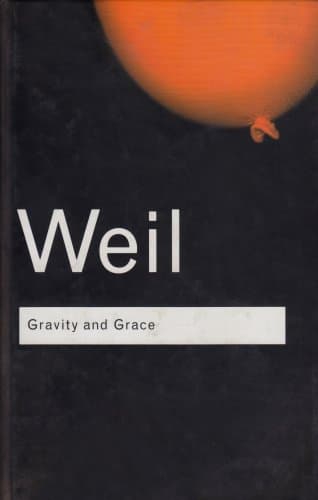
Gravity and Grace
الجاذبية والنعمة
Pesanteur et grâce
Editorial summary
This posthumous collection of Simone Weil's philosophical and spiritual reflections, compiled from her notebooks by Gustave Thibon, presents a distinctive contribution to twentieth-century religious thought through its paradoxical exploration of divine absence and presence. Weil develops a theological anthropology centered on the concept of "decreation," wherein the human soul must empty itself of ego and false attachments to create space for divine grace. Her analysis challenges conventional theistic frameworks by insisting that authentic contact with God requires passage through experiences of affliction, abandonment, and spiritual desolation.
The work's central dialectic between gravity and grace structures Weil's understanding of the human condition. She characterizes "gravity" as the natural tendency of human consciousness toward self-centeredness, illusion, and attachment to finite goods. Against this downward pull, grace operates as a supernatural force that can elevate the soul only when it has ceased its own striving and consented to its radical dependence. This framework leads Weil to provocative conclusions about religious experience, including her assertion that true faith must pass through atheism and that God's apparent absence constitutes a form of divine presence.
Weil's method combines rigorous philosophical analysis with mystical insight, drawing on Platonic metaphysics, Christian mysticism, and Hindu philosophy while maintaining critical distance from institutional religion. Her critique extends to conventional theodicy, as she refuses consolatory explanations for suffering and instead locates redemptive possibility within affliction itself. The work engages implicitly with both rationalist dismissals of religious experience and sentimental forms of popular piety, offering instead a severe vision of spiritual transformation through self-emptying.
The collection's significance for the God debate lies in its articulation of a religious position that embraces doubt, suffering, and divine hiddenness as essential rather than problematic features of authentic faith. Weil's insistence on the spiritual value of experiencing God's absence provides a sophisticated response to arguments from divine hiddenness while challenging comfortable assumptions about religious consolation. Her work anticipates later developments in negative theology and religious responses to post-Holocaust theological crisis. Through its unflinching examination of spiritual desolation and its paradoxical affirmation of a God who withdraws to make room for creation, the text offers a unique perspective on perennial questions about divine presence, human suffering, and the possibility of transcendence.
Argument formulations engaged
Weil, Simone (1947). Gravity and Grace. Routledge.
@book{gravity-and-grace-1947,
  author    = {Weil, Simone},
  title     = {Gravity and Grace},
  year      = {1947},
  publisher = {Routledge},
  url       = {https://god-database.com/en/works/gravity-and-grace-1947}
}