
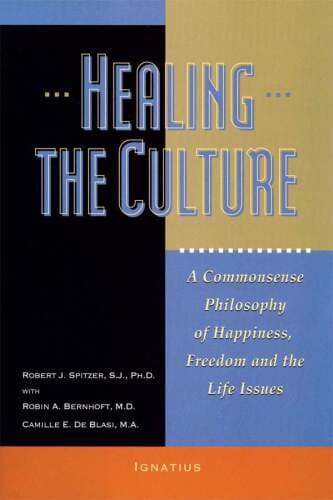
Healing the Culture: A Commonsense Philosophy of Happiness, Freedom, and the Life Issues
شفاء الثقافة: فلسفة الحس السليم للسعادة والحرية وقضايا الحياة
Guérir la culture : Une philosophie de bon sens du bonheur, de la liberté et des questions de vie
Editorial summary
This monograph presents a systematic philosophical framework for addressing contemporary moral issues, particularly abortion and euthanasia, through a recovery of classical metaphysical principles. Spitzer constructs a four-level hierarchy of human purpose that moves from immediate gratification through ego satisfaction and contributive meaning to ultimate transcendent purpose. This teleological structure serves as the foundation for what he terms a "commonsense philosophy" capable of healing what he diagnoses as profound cultural dysfunction.
The work engages critically with utilitarian and relativistic ethical frameworks that dominate contemporary bioethical discourse. Against Peter Singer's preference utilitarianism and situational ethics approaches, Spitzer deploys a neo-Thomistic argument that grounds human dignity in the soul's transcendent dimension. He contends that cultural acceptance of life-terminating practices stems from a truncated anthropology that reduces human purpose to the lower levels of his hierarchy, particularly pleasure and ego satisfaction.
Methodologically, Spitzer combines philosophical argumentation with cultural criticism, examining how media, education, and popular culture reinforce what he identifies as Level 1 and Level 2 conceptions of happiness. His analysis extends beyond abstract reasoning to propose concrete cultural interventions, including educational curricula and media strategies designed to elevate public discourse toward Level 3 and Level 4 purposes. This practical dimension distinguishes his approach from purely academic treatments of these issues.
The theological implications emerge most clearly in Spitzer's treatment of Level 4 purpose, which he identifies with the human desire for perfect truth, love, justice, beauty, and being. While avoiding explicitly confessional language, he argues that this transcendent orientation points toward divine reality as the only adequate fulfillment of human longing. The soul's capacity for infinite desire becomes evidence for its divine origin and destiny.
The monograph's significance lies in its attempt to bridge academic philosophy and public policy debates through accessible yet rigorous argumentation. Spitzer positions his work against both secular bioethics and fideistic approaches that bypass rational discourse. His "commonsense" label signals an appeal to broadly shared intuitions about human dignity while grounding these intuitions in sophisticated metaphysical analysis. The work thus contributes to natural law revival movements seeking to establish objective moral foundations for public discourse on life issues without relying exclusively on revealed theology.
Argument formulations engaged
Spitzer, Robert J. (2000). Healing the Culture: A Commonsense Philosophy of Happiness, Freedom, and the Life Issues. Ignatius Press.
@book{healing-the-culture-a-commonsense-philos,
  author    = {Spitzer, Robert J.},
  title     = {Healing the Culture: A Commonsense Philosophy of Happiness, Freedom, and the Life Issues},
  year      = {2000},
  publisher = {Ignatius Press},
  url       = {https://god-database.com/en/works/healing-the-culture-a-commonsense-philosophy-of-happiness-freedom-and-the-life-issues-2000}
}