
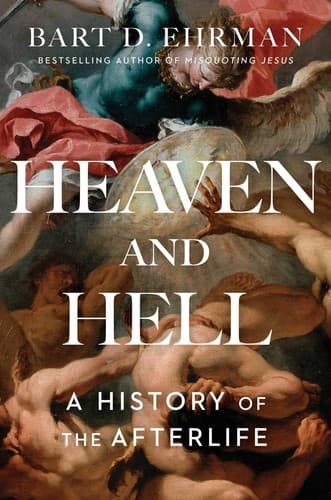
Heaven and Hell
الجنة والجحيم
Paradis et enfer
Editorial summary
This historical monograph traces the development of afterlife beliefs in Western religious thought, demonstrating how concepts of heaven and hell emerged gradually rather than appearing fully formed in early biblical texts. Ehrman employs critical historical methodology to examine Jewish and Christian sources from ancient Near Eastern texts through late antiquity, revealing significant evolution in eschatological thinking over centuries.
The work challenges popular assumptions about biblical teachings on the afterlife. Ehrman shows that Hebrew Bible texts predominantly present death as final, with sheol conceived as a shadowy underworld rather than a place of reward or punishment. He traces how apocalyptic Judaism, influenced by Persian dualism and Hellenistic thought, introduced notions of resurrection and judgment. Early Jesus traditions, he argues, centered on imminent earthly transformation rather than individual postmortem destinations. The familiar heaven-hell dichotomy emerges fully only in later Christian writings, reaching elaborate form in works like the Apocalypse of Peter and Dante's Divine Comedy.
Ehrman's analysis directly confronts traditional Christian apologetics that treat heaven and hell as consistent biblical doctrines. His historical-critical approach demonstrates these beliefs resulted from cultural synthesis and theological development rather than divine revelation. The work particularly emphasizes how afterlife beliefs served social functions, providing theodicy for suffering and moral incentive for behavior. This functional analysis implicitly challenges supernatural explanations for religious belief formation.
The monograph contributes to broader debates about religious authority and the nature of scripture. By documenting dramatic shifts in afterlife concepts even within canonical texts, Ehrman undermines fundamentalist claims about biblical consistency and divine authorship. His methodology assumes naturalistic explanations for religious phenomena, treating theological ideas as human cultural products shaped by historical circumstances.
While focusing on historical development rather than philosophical arguments about God's existence, the work carries significant implications for theistic belief. If central doctrines like heaven and hell represent human constructions evolving over time rather than revealed truths, this raises questions about divine communication and religious epistemology. Ehrman's careful documentation of belief transformation challenges believers to reconsider the foundations of theological claims. The monograph thus serves as indirect critique of traditional theism through historical analysis, demonstrating how supposedly eternal truths emerge from temporal cultural processes.
Argument formulations engaged
Ehrman, Bart (2020). Heaven and Hell.
@book{heaven-and-hell-2020,
  author    = {Ehrman, Bart},
  title     = {Heaven and Hell},
  year      = {2020},
  url       = {https://god-database.com/en/works/heaven-and-hell-2020}
}