
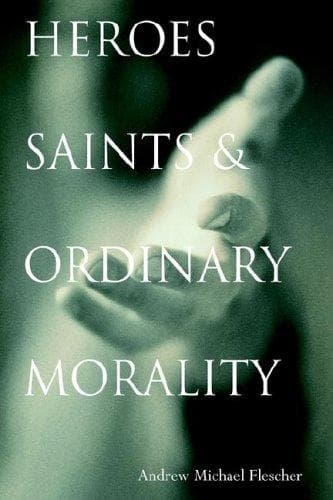
Heroes, Saints, and Ordinary Morality
الأبطال والقديسون والأخلاق العادية
Héros, saints et moralité ordinaire
Editorial summary
This monograph examines the relationship between extraordinary moral exemplars and ordinary ethical life, challenging prevailing philosophical assumptions about moral heroism and sainthood. Flescher develops a sustained critique of the "supererogationist" position, which holds that heroic and saintly acts exist beyond the demands of ordinary morality in a special category of moral excellence that transcends obligation. Against this view, the work argues that heroes and saints operate within the same moral framework as everyone else, differing in degree rather than kind from ordinary moral agents.
The analysis proceeds through careful examination of philosophical treatments of moral exemplarity, particularly engaging with contemporary ethicists who have defended supererogationism. Flescher demonstrates how the tendency to place heroes and saints in a separate moral category stems from misunderstandings about the nature of moral motivation and obligation. The work draws on virtue ethics and moral psychology to show that extraordinary moral acts emerge from the same sources of moral agency available to all persons, though developed to exceptional degrees.
Central to Flescher's argument is a reconceptualization of moral obligation that resists sharp distinctions between required and supererogatory acts. The monograph contends that what appears as moral heroism or saintliness represents the full actualization of moral capacities that exist in nascent form in ordinary moral life. This perspective has significant implications for how moral education and formation are understood, suggesting that extraordinary virtue is cultivated through practices accessible to ordinary moral agents rather than through some special dispensation or calling.
While not primarily a work in philosophy of religion, the monograph engages substantively with religious conceptions of sainthood and their relationship to theological understandings of grace, virtue, and human nature. Flescher examines how religious traditions have understood the relationship between divine action and human moral agency in the lives of saints, arguing for interpretations that emphasize continuity between saintly virtue and ordinary moral development. The work thus contributes to debates about whether moral excellence requires special divine intervention or emerges through natural human capacities. This naturalistic account of moral exemplarity suggests that heroism and saintliness can be understood without necessary reference to supernatural assistance, though the work remains open to religious interpretations that see divine action operating through rather than despite natural moral processes.
Argument formulations engaged
Flescher, Andrew Michael (2003). Heroes, Saints, and Ordinary Morality. Philosophy Documentation Center.
@book{heroes-saints-and-ordinary-morality-2003,
  author    = {Flescher, Andrew Michael},
  title     = {Heroes, Saints, and Ordinary Morality},
  year      = {2003},
  publisher = {Philosophy Documentation Center},
  url       = {https://god-database.com/en/works/heroes-saints-and-ordinary-morality-2003}
}