
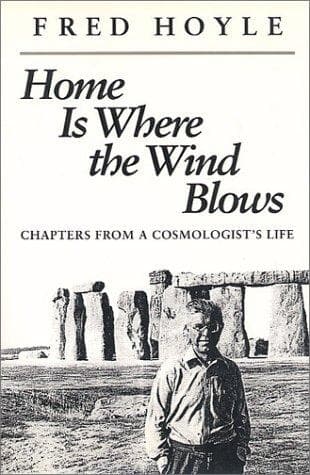
Home Is Where the Wind Blows: Chapters from a Cosmologist's Life
البيت حيث تهب الريح: فصول من حياة عالم كونيات
La maison est là où souffle le vent : Chapitres de la vie d'un cosmologiste
Editorial summary
This autobiographical work by Fred Hoyle provides crucial insight into one of the most significant cosmological debates of the 20th century, with profound implications for natural theology and the question of cosmic origins. Hoyle recounts his scientific journey, including his development of the steady-state theory of the universe and his eventual confrontation with evidence supporting the Big Bang model. His narrative illuminates how cosmological theories intersect with fundamental questions about creation, design, and the possibility of divine agency in the universe.
Hoyle's account reveals the philosophical stakes underlying competing cosmological models. The steady-state theory, which he championed alongside Hermann Bondi and Thomas Gold, posited an eternal universe with continuous creation of matter, effectively eliminating the need for an initial creation event. This model held obvious appeal for those seeking to avoid the theological implications of a cosmic beginning. Conversely, the Big Bang theory, with its singular origin point, appeared more compatible with traditional creation narratives, leading some to view it as indirect support for theistic claims about divine creation.
The work documents Hoyle's gradual acceptance of Big Bang cosmology while maintaining his skepticism toward its theological appropriation. He describes his famous prediction of the cosmic microwave background radiation's temperature and his subsequent acknowledgment of the mounting evidence against steady-state theory. Particularly significant is Hoyle's discussion of stellar nucleosynthesis and the anthropic coincidences he discovered in carbon formation. His observation that the universe appears "fine-tuned" for life led him to suggest that "a superintellect has monkeyed with physics," though he resisted identifying this with any traditional conception of God.
Throughout the narrative, Hoyle grapples with what he terms the "religion versus science" dichotomy, arguing that both steady-state and Big Bang cosmologies can be interpreted through either naturalistic or theological lenses. His reflections on the limits of scientific explanation and the persistence of ultimate questions about existence contribute to ongoing debates about methodological naturalism and the proper boundaries between science and theology. The work serves as both a historical document of a major scientific transition and a philosophical meditation on how cosmological discoveries shape our understanding of ultimate reality and the possible role of transcendent causation in cosmic history.
Argument formulations engaged
Hoyle, Fred (1994). Home Is Where the Wind Blows: Chapters from a Cosmologist's Life. University Science Books.
@book{home-is-where-the-wind-blows-chapters-fr,
  author    = {Hoyle, Fred},
  title     = {Home Is Where the Wind Blows: Chapters from a Cosmologist's Life},
  year      = {1994},
  publisher = {University Science Books},
  url       = {https://god-database.com/en/works/home-is-where-the-wind-blows-chapters-from-a-cosmologists-life-1994}
}