
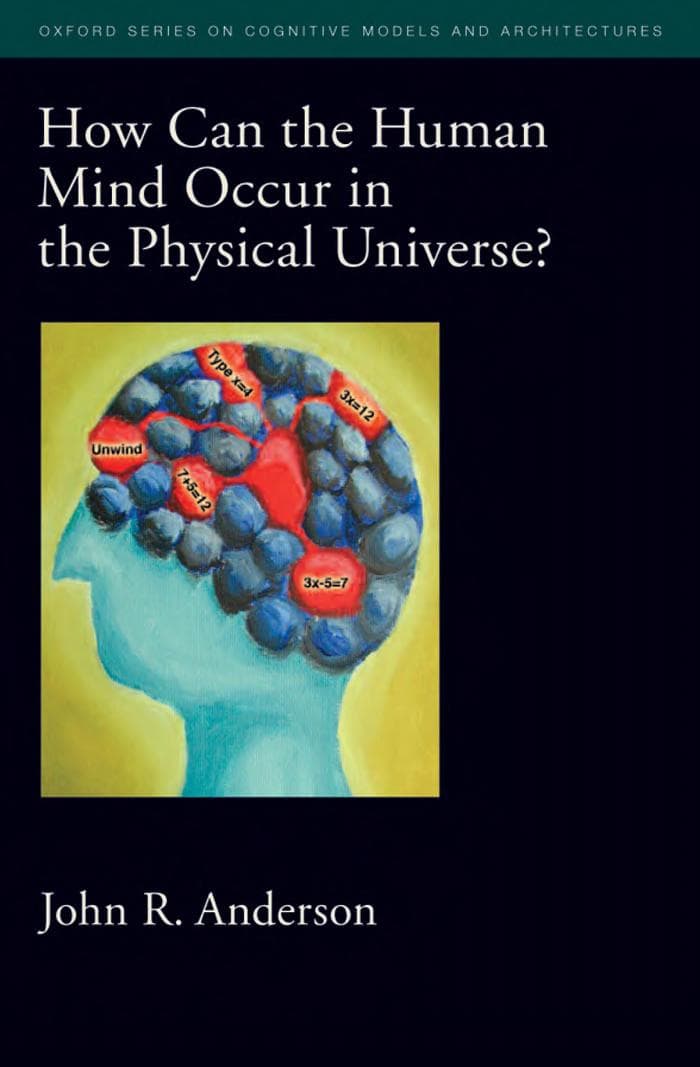
How Can the Human Mind Occur in the Physical Universe
كيف يمكن أن يوجد العقل البشري في الكون المادي
Comment l'esprit humain peut-il exister dans l'univers physique
The human mind, with its remarkable cognitive capacities, can be understood as emerging from physical processes through computational and neural mechanisms, as modeled by the ACT-R cognitive architecture.
Editorial summary
John R. Anderson's monograph examines one of the most profound questions at the intersection of cognitive science and philosophy: how conscious experience emerges from physical processes in the brain. While not explicitly addressing theological questions, Anderson's work engages deeply with issues central to the God debate, particularly regarding the nature of consciousness and its relationship to material reality.
Anderson approaches the mind-body problem through the lens of cognitive architecture, drawing on his decades of research developing the ACT-R (Adaptive Control of Thought-Rational) theory. The work synthesizes findings from neuroscience, psychology, and computational modeling to argue that human cognition can be understood as arising from the interaction of multiple information-processing systems operating according to rational principles. This mechanistic account challenges dualist conceptions of mind that have historically supported certain theological arguments about the soul and divine creation.
The monograph's significance to the God debate lies primarily in its implications for consciousness arguments. By providing a detailed computational account of how complex mental phenomena emerge from neural processes, Anderson offers a naturalistic alternative to explanations that invoke non-physical or supernatural elements. His work engages indirectly with philosophical traditions that use the apparent irreducibility of consciousness as evidence for divine design or intervention.
Anderson's methodology combines empirical research with computational modeling, demonstrating how cognitive functions previously thought to require immaterial explanation can be reproduced in artificial systems. This approach aligns with broader scientific efforts to naturalize the mind, though Anderson maintains a descriptive rather than polemical stance throughout. He focuses on explaining how consciousness occurs rather than arguing against religious interpretations of mental phenomena.
The intellectual context of Anderson's work includes ongoing debates in cognitive science about the sufficiency of computational approaches to explain subjective experience. While his ACT-R framework successfully models many aspects of human cognition, questions remain about whether such models can fully account for phenomenal consciousness. These limitations leave space for continued dialogue between scientific and theological perspectives on the nature of mind.
Anderson's contribution represents a significant advance in understanding the physical basis of cognition, providing detailed mechanisms for mental processes that religious traditions have often attributed to immaterial souls. His work exemplifies how cognitive science can inform philosophical and theological discussions about human nature without necessarily adopting an explicitly atheistic stance.
Structured analysis
Structure of the work
Argument formulations engaged
Anderson, John R. (2007). How Can the Human Mind Occur in the Physical Universe.
@book{how-can-the-human-mind-occur-in-the-phys,
  author    = {Anderson, John R.},
  title     = {How Can the Human Mind Occur in the Physical Universe},
  year      = {2007},
  url       = {https://god-database.com/en/works/how-can-the-human-mind-occur-in-the-physical-universe}
}