
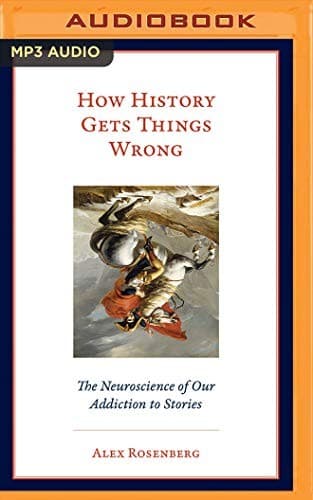
How History Gets Things Wrong: The Neuroscience of Our Addiction to Stories
كيف يخطئ التاريخ: علم الأعصاب وإدماننا على القصص
Comment l'histoire se trompe : La neuroscience de notre addiction aux histoires
Editorial summary
Alex Rosenberg's provocative monograph mounts a systematic attack on narrative explanation in history and everyday life, grounding his critique in contemporary neuroscience and evolutionary theory. The work extends his eliminative materialist program to challenge the widespread assumption that human actions can be understood through stories about beliefs, desires, and intentions. Rosenberg argues that the human brain's evolved propensity for "mind reading" through narrative construction, while adaptive in our evolutionary past, fundamentally misrepresents the actual causal mechanisms driving behavior.
Drawing extensively on neuroscientific research, particularly studies of neural structures and information processing, Rosenberg contends that the brain does not store or retrieve information in narrative form. Instead, neural processes operate through distributed networks and pattern recognition systems that bear no resemblance to the sequential, intentional structures of stories. The "theory of mind" that enables humans to construct narratives about others' mental states evolved for quick social navigation, not accurate causal explanation. This mismatch between our narrative cognitive tools and actual causal reality undermines both historical explanation and folk psychology.
The implications for understanding human behavior and social phenomena prove radical. Rosenberg argues that historians' reliance on documentary evidence to reconstruct past actors' motivations and decisions rests on a fundamental category error. Historical narratives, however compelling, cannot capture the actual neurological and environmental factors that produce behavior. Similarly, our everyday explanations of actions through beliefs and desires reflect evolutionary shortcuts rather than genuine causal understanding.
While not explicitly focused on religious questions, the work carries significant implications for the God debate. Rosenberg's thoroughgoing naturalism and reduction of mental phenomena to neural processes leaves no room for divine action, religious experience as veridical, or any non-physical causation. His critique of narrative understanding undermines religious accounts of meaning, purpose, and divine providence in history. The elimination of genuine intentionality extends logically to divine intentionality, making traditional theistic concepts incoherent within his framework.
The monograph represents a bold application of neuroscientific findings to fundamental questions in philosophy of mind, history, and human self-understanding. Critics challenge both his interpretation of neuroscience and the coherence of eliminating the very intentional concepts required to conduct scientific inquiry. Nevertheless, Rosenberg's work exemplifies how contemporary naturalism deploys empirical science to dissolve traditional philosophical categories, including those essential to religious worldviews.
Argument formulations engaged
Related works
Rosenberg, Alex (2018). How History Gets Things Wrong: The Neuroscience of Our Addiction to Stories. MIT Press.
@book{how-history-gets-things-wrong-the-neuros,
  author    = {Rosenberg, Alex},
  title     = {How History Gets Things Wrong: The Neuroscience of Our Addiction to Stories},
  year      = {2018},
  publisher = {MIT Press},
  url       = {https://god-database.com/en/works/how-history-gets-things-wrong-the-neuroscience-of-our-addiction-to-stories-2018}
}