
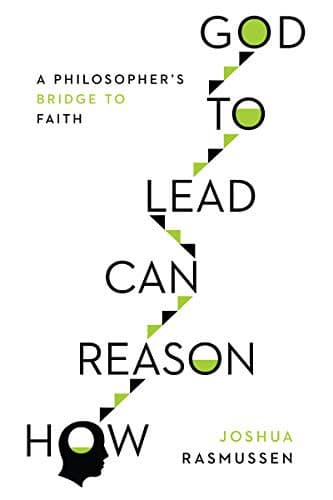
How Reason Can Lead to God
كيف يمكن للعقل أن يقود إلى الله
Comment la raison peut mener à Dieu
Rasmussen argues that careful philosophical reasoning, proceeding from widely shared rational intuitions and basic logical principles, can lead an open-minded inquirer step by step to the existence of a personal, ultimate ground of all reality.
Editorial summary
This monograph presents a systematic philosophical case for theism through carefully constructed rational argumentation. Joshua Rasmussen develops what he terms a "bridge" from observable reality to the existence of a necessary foundation, which he identifies as God. The work operates within the analytic philosophical tradition, employing rigorous logical analysis while maintaining accessibility for non-specialists seeking to understand how reason might support theistic belief.
Rasmussen's central strategy involves building a cumulative case through interconnected arguments rather than relying on any single proof. He begins with minimal metaphysical commitments that most readers would accept—such as the existence of contingent things—and proceeds through incremental steps toward more substantive conclusions. The cosmological reasoning forms the backbone of his approach, as he argues from the existence of contingent reality to the necessity of an uncaused cause. Unlike classical formulations that might seem remote from contemporary thought, Rasmussen grounds his arguments in everyday observations about causation and explanation.
The work engages seriously with prominent objections from naturalistic philosophers, particularly addressing concerns raised by thinkers like Graham Oppy and J.L. Mackie. Rasmussen examines whether a necessary foundation must possess the attributes traditionally associated with God, such as consciousness and intentionality. His treatment of the ontological argument appears not as a standalone proof but as a complement to his cosmological reasoning, helping to illuminate the nature of necessary existence.
A distinctive feature of Rasmussen's methodology involves what he calls "reason maps"—visual representations that clarify the logical connections between premises and conclusions. This pedagogical innovation reflects his commitment to making rigorous philosophy accessible without sacrificing analytical precision. The work also incorporates elements of modal logic and contemporary metaphysics, showing how recent developments in these fields can strengthen classical theistic arguments.
The monograph's significance lies in its fresh presentation of traditional arguments using contemporary analytical tools, its systematic engagement with naturalistic alternatives, and its methodological innovations in presenting complex philosophical reasoning. Rasmussen demonstrates that theistic belief need not rest on faith alone but can emerge from careful rational reflection on the nature of reality. His work contributes to ongoing debates about explanation, necessity, and the rational grounds for religious belief within contemporary analytic philosophy.
Argument formulations engaged
Related works
Rasmussen, Joshua How Reason Can Lead to God.
@book{how-reason-can-lead-to-god,
  author    = {Rasmussen, Joshua},
  title     = {How Reason Can Lead to God},
  year      = {n.d.},
  url       = {https://god-database.com/en/works/how-reason-can-lead-to-god}
}