
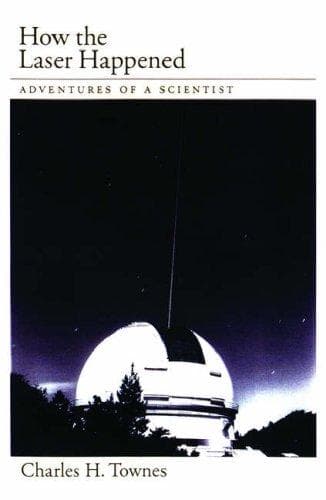
How the Laser Happened: Adventures of a Scientist
كيف حدث الليزر: مغامرات عالم
Comment le laser est arrivé : Aventures d'un scientifique
Editorial summary
This autobiographical work by Nobel laureate Charles H. Townes offers a unique perspective on the relationship between scientific discovery and religious faith. While primarily chronicling the invention of the laser and maser, Townes weaves throughout his narrative a sustained reflection on the compatibility of scientific inquiry with belief in God. The physicist presents his life's work as evidence that science and religion, far from being antagonistic, represent complementary approaches to understanding reality.
Townes directly challenges the prevalent assumption that serious scientists must adopt materialist or atheistic worldviews. He argues that the order and elegance revealed by physics point toward divine intelligence rather than away from it. His account describes numerous instances where scientific breakthroughs emerged through processes resembling religious insight - sudden intuitions, moments of clarity, and what he terms "revelations" about natural phenomena. The invention of the maser itself, as Townes recounts, came through an epiphanic moment that he explicitly compares to religious experience.
The work engages with the mid-twentieth century debate between logical positivists and religious thinkers, positioning itself against both rigid scientism and anti-scientific fundamentalism. Townes contends that both science and religion involve faith - scientists must trust in the rationality of the universe and the reliability of human reason. He sees his scientific achievements not as replacements for religious understanding but as explorations of divine creation through natural means.
Methodologically, Townes employs personal narrative as philosophical argument. By demonstrating how a leading physicist maintains deep religious convictions while conducting groundbreaking research, he offers an existence proof against the incompatibility thesis. His approach differs markedly from natural theology's attempts to prove God through science; instead, he shows how scientific practice can coexist with and even be enriched by theological conviction.
The significance of this work lies in its author's scientific credentials combined with his unapologetic theism. Townes provides ammunition for those arguing against the conflict model of science and religion, while offering a lived example of integrated faith and reason. His perspective anticipates later discussions about methodological naturalism and the limits of scientific explanation, contributing a practitioner's voice to debates often dominated by philosophers and theologians.
Argument formulations engaged
Townes, Charles H. (1999). How the Laser Happened: Adventures of a Scientist.
@book{how-the-laser-happened-adventures-of-a-s,
  author    = {Townes, Charles H.},
  title     = {How the Laser Happened: Adventures of a Scientist},
  year      = {1999},
  url       = {https://god-database.com/en/works/how-the-laser-happened-adventures-of-a-scientist-1999}
}