
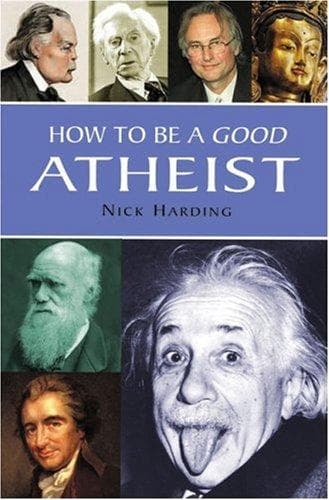
How to be a Good Atheist
كيف تكون ملحداً جيداً
Comment être un bon athée
Atheism is not merely the absence of belief but a coherent and ethically defensible position that can be lived with intellectual honesty and moral seriousness.
Editorial summary
Nick Harding's How to be a Good Atheist presents a comprehensive guide for those who have rejected religious belief or are questioning their faith, offering both philosophical justification for atheism and practical advice for living without religion. The work engages primarily with contemporary Anglo-American atheist discourse, positioning itself as both an intellectual defense of atheism and a handbook for navigating a predominantly religious society.
Harding employs a descriptive-analytical approach that combines philosophical argumentation with sociological observation. The text systematically addresses common challenges faced by atheists, from responding to religious arguments to handling family relationships and ethical decision-making without divine command theory. His methodology involves examining religious claims through the lens of scientific rationalism while acknowledging the social and emotional dimensions of religious deconversion.
The work's engagement with the problem of evil forms a central pillar of its atheistic case. Harding presents the existence of suffering as fundamentally incompatible with the concept of an omnipotent, omnibenevolent deity, drawing on both classical formulations and contemporary examples. He extends this analysis beyond mere philosophical abstraction, examining how believers' attempts to reconcile suffering with divine goodness often lead to moral contradictions and psychological harm.
In addressing cumulative case arguments for theism, Harding adopts a systematic deconstruction approach. He examines various strands of evidence that believers weave together - from cosmological arguments to religious experience claims - and argues that each strand, when examined independently, fails to support theistic conclusions. His analysis emphasizes how the apparent strength of cumulative arguments often derives from psychological tendencies toward pattern recognition and confirmation bias rather than logical validity.
The work's significance lies in its dual function as both philosophical critique and practical guide. Unlike purely academic treatments of atheism, Harding addresses the lived experience of non-belief in religious societies. He provides frameworks for constructing meaning, purpose, and community without religious structures, while acknowledging the genuine human needs that religions have historically addressed. The text contributes to the growing literature on "positive atheism" that moves beyond mere rejection of religious claims to construct alternative frameworks for human flourishing. This approach reflects the broader shift in early twenty-first century atheist discourse from defensive positioning to proactive worldview construction.
Structured analysis
Structure of the work
Argument formulations engaged
Harding, Nick (2007). How to be a Good Atheist. Oldcastle Books.
@book{how-to-be-a-good-atheist,
  author    = {Harding, Nick},
  title     = {How to be a Good Atheist},
  year      = {2007},
  publisher = {Oldcastle Books},
  url       = {https://god-database.com/en/works/how-to-be-a-good-atheist}
}