
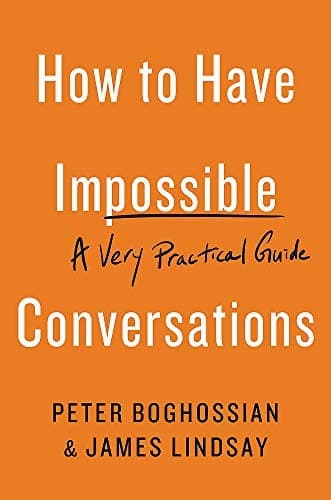
How to Have Impossible Conversations: A Very Practical Guide
كيف تخوض محادثات مستحيلة: دليل عملي جداً
Comment avoir des conversations impossibles : Un guide très pratique
Editorial summary
This practical guide addresses the breakdown of civil discourse in contemporary society, offering techniques for engaging productively across ideological divides. While not explicitly focused on religious debates, the work provides tools highly applicable to conversations about God, faith, and atheism, areas where Boghossian has extensive experience as a philosophy educator and public intellectual.
The book emerges from Boghossian's background in critical thinking pedagogy and his controversial public engagements around faith and reason. Drawing on his experience teaching philosophy in prisons and his work on epistemology, he develops a methodology for navigating conversations where participants hold fundamentally different worldviews. The approach combines Socratic questioning with insights from psychology, conflict resolution, and street epistemology, a movement Boghossian helped pioneer for engaging religious believers in discussions about their faith.
Central to the method is the distinction between facts and values, and the recognition that most intractable disagreements stem from differing moral intuitions rather than factual disputes. Boghossian advocates beginning conversations by identifying shared values and building rapport before addressing contentious claims. He emphasizes asking open-ended questions that encourage interlocutors to examine their own reasoning processes rather than defending fixed positions. The technique aims to increase intellectual humility and openness to revising beliefs based on evidence.
The work provides specific strategies for defusing hostility, including acknowledging uncertainty, steelmanning opposing positions, and avoiding tribal signaling. Boghossian warns against common conversational pitfalls such as using complex vocabulary to intimidate, making assumptions about others' motivations, and conflating disagreement with moral failing. He illustrates principles through hypothetical dialogues addressing topics like immigration, gender identity, and religious faith.
While the book maintains a neutral stance on specific ideological positions, its underlying epistemology favors empiricism and skepticism toward claims lacking evidential support. This framework, though not explicitly atheistic, aligns with methodological naturalism. The techniques presented could theoretically be employed by believers and nonbelievers alike, though the emphasis on evidence-based reasoning and challenging unexamined beliefs reflects values typically associated with secular philosophy.
The work contributes to the God debate indirectly by providing tools for more productive engagement between believers and skeptics. Its significance lies in offering practical methods for moving beyond entrenched positions toward genuine dialogue, potentially enabling progress in discussions that often generate more heat than light.
Boghossian, Peter (2019). How to Have Impossible Conversations: A Very Practical Guide. Lifelong Books.
@book{how-to-have-impossible-conversations-a-v,
  author    = {Boghossian, Peter},
  title     = {How to Have Impossible Conversations: A Very Practical Guide},
  year      = {2019},
  publisher = {Lifelong Books},
  url       = {https://god-database.com/en/works/how-to-have-impossible-conversations-a-very-practical-guide-2019}
}