
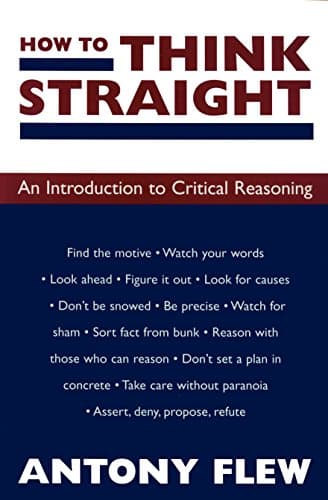
How to Think Straight: An Introduction to Critical Reasoning
كيف تفكر بوضوح: مقدمة في التفكير النقدي
Comment penser droit : Une introduction au raisonnement critique
Editorial summary
Antony Flew's "How to Think Straight: An Introduction to Critical Reasoning" represents a significant contribution to philosophical methodology with direct implications for theological discourse. While ostensibly a general primer on critical thinking, the work systematically addresses fallacious reasoning patterns frequently encountered in arguments about God's existence, religious belief, and theological claims. Flew, drawing on his extensive background in philosophy of religion, constructs a framework for evaluating arguments that proves particularly effective when applied to metaphysical and theological propositions.
The monograph advances its thesis through careful examination of common logical fallacies and argumentative strategies that obscure rather than illuminate truth. Flew demonstrates how appeals to authority, question-begging arguments, and various forms of special pleading regularly infiltrate discussions about divine existence and religious experience. His analysis reveals how theological arguments often rely on ambiguous terminology, shifting definitions, and unfalsifiable claims that resist rational scrutiny. The work particularly emphasizes the importance of establishing clear criteria for evidence and maintaining consistent standards of proof across all domains of inquiry, including religious ones.
Flew's methodological approach combines formal logical analysis with practical examples drawn from philosophical and theological debates. He argues against what he terms "the presumption of atheism" while simultaneously critiquing weak theistic arguments, positioning critical reasoning as a neutral tool that should be applied uniformly regardless of one's prior commitments. The text engages with classical philosophical problems such as the burden of proof, the nature of evidence, and the relationship between faith and reason, demonstrating how proper reasoning techniques can clarify rather than resolve these perennial questions.
The work's significance lies in its implicit challenge to both theistic and atheistic positions that rely on poor reasoning. Flew contends that many debates about God founder not on substantive disagreements but on fundamental logical errors that critical thinking can expose. His emphasis on intellectual honesty and methodological rigor establishes standards for theological discourse that demand precision in argumentation. By providing tools for identifying and avoiding fallacious reasoning, the monograph equips readers to engage more productively with questions about divine existence, religious knowledge, and the rational foundations of belief. The text thus serves as both a practical guide to clear thinking and a sophisticated intervention in philosophy of religion, advocating for higher standards of argumentation in theological debate.
Related works
Flew, Antony (1998). How to Think Straight: An Introduction to Critical Reasoning. Prometheus.
@book{how-to-think-straight-an-introduction-to,
  author    = {Flew, Antony},
  title     = {How to Think Straight: An Introduction to Critical Reasoning},
  year      = {1998},
  publisher = {Prometheus},
  url       = {https://god-database.com/en/works/how-to-think-straight-an-introduction-to-critical-reasoning-1998}
}