
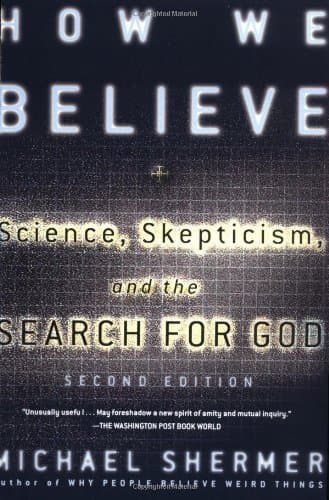
How We Believe: The Search for God in an Age of Science
كيف نؤمن: البحث عن الله في عصر العلم
Comment nous croyons : La recherche de Dieu à l'âge de la science
Editorial summary
In How We Believe: The Search for God in an Age of Science, Michael Shermer examines religious belief through the lens of scientific skepticism and evolutionary psychology. Drawing on extensive survey data from over 10,000 Americans, Shermer investigates why people believe in God, how these beliefs function in modern society, and what science reveals about the psychological and social mechanisms underlying religious faith.
The work develops a naturalistic account of religious belief, arguing that humans are predisposed to believe in supernatural agents due to evolutionary factors. Shermer identifies what he terms "agenticity" - the tendency to infuse patterns with meaning and intention - as a fundamental cognitive bias that leads people to perceive design and purpose in random events. This pattern-seeking behavior, while adaptive for survival, creates a propensity for supernatural beliefs when applied to existential questions. He complements this analysis with "patternicity," the tendency to find meaningful patterns in meaningless noise, suggesting these twin cognitive biases form the psychological foundation of religious belief.
Shermer's methodology combines empirical research with philosophical argumentation. His survey data reveals that most Americans believe in God for emotional rather than rational reasons, with personal experiences and the desire for meaning ranking above logical arguments. He examines how beliefs cluster differently among various demographic groups and explores the correlation between scientific literacy and religious skepticism. The work directly challenges arguments from design, particularly those advanced by proponents of intelligent design theory, demonstrating how apparent design in nature emerges through natural selection without requiring supernatural intervention.
The book engages critically with both traditional theological arguments and contemporary attempts to reconcile science with religion. Shermer argues against Stephen Jay Gould's concept of non-overlapping magisteria, contending that science and religion make competing claims about reality that cannot be compartmentalized. He examines why scientists tend toward lower rates of religious belief while acknowledging that some prominent scientists maintain religious faith.
Shermer's contribution to the God debate lies in his systematic application of skeptical inquiry to religious phenomena, treating belief as a natural phenomenon subject to scientific investigation. His work provides a comprehensive naturalistic framework for understanding why religious belief persists in scientifically advanced societies. By combining evolutionary psychology, cognitive science, and sociological analysis, Shermer offers a influential skeptical perspective on the origins and persistence of belief in God, positioning religious faith as a byproduct of cognitive mechanisms rather than a response to divine reality.
Argument formulations engaged
Related works
Shermer, Michael (2000). How We Believe: The Search for God in an Age of Science. W. H. Freeman.
@book{how-we-believe-the-search-for-god-in-an-,
  author    = {Shermer, Michael},
  title     = {How We Believe: The Search for God in an Age of Science},
  year      = {2000},
  publisher = {W. H. Freeman},
  url       = {https://god-database.com/en/works/how-we-believe-the-search-for-god-in-an-age-of-science-2000}
}