
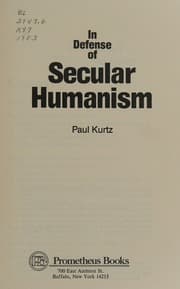
In Defense of Secular Humanism
في الدفاع عن الإنسانية العلمانية
En défense de l'humanisme séculier
Editorial summary
Paul Kurtz's In Defense of Secular Humanism presents a comprehensive philosophical framework for understanding human existence and ethics without reference to supernatural or religious foundations. Writing in 1983, Kurtz responds to the resurgent religious fundamentalism of the era by articulating a robust alternative worldview that grounds meaning, morality, and human flourishing in naturalistic and humanistic principles.
The work systematically addresses three central challenges to secular humanism: that it lacks a foundation for ethics, that it cannot provide meaning or purpose, and that it represents a destructive force in society. Against these charges, Kurtz develops what he terms "eupraxophy" - a philosophy that emphasizes practical wisdom and ethical living based on scientific inquiry and rational deliberation. He argues that moral values emerge from human experience and needs rather than divine commands, and that ethical principles can be justified through their consequences for human well-being.
Kurtz's methodology combines philosophical analysis with empirical observation, drawing on evolutionary theory, psychology, and sociology to support his claims. He contends that secular humanism offers a more reliable basis for ethics than religious systems because it remains open to revision based on evidence and changing circumstances. The work explicitly challenges both traditional theistic ethics and nihilistic relativism, positioning secular humanism as a constructive middle path that affirms objective values while rejecting supernatural metaphysics.
A significant portion of the text addresses the psychological and social dimensions of religious belief, examining why supernatural worldviews persist despite scientific advancement. Kurtz argues that secular humanism can fulfill the emotional and communal needs traditionally met by religion while avoiding the dogmatism and authoritarianism he associates with theistic systems. He emphasizes education, critical thinking, and democratic values as essential components of a humanistic society.
The work's contribution to debates about God lies in its comprehensive articulation of a non-theistic worldview that claims to preserve the ethical and existential goods traditionally associated with religion. Kurtz demonstrates that rejecting belief in God need not lead to moral nihilism or existential despair. His defense of secular humanism remains influential in contemporary discussions about the relationship between religion, ethics, and human flourishing, particularly in debates about whether morality requires religious foundations.
Argument formulations engaged
Related works
Kurtz, Paul (1983). In Defense of Secular Humanism. Prometheus Books.
@book{in-defense-of-secular-humanism-1983,
  author    = {Kurtz, Paul},
  title     = {In Defense of Secular Humanism},
  year      = {1983},
  publisher = {Prometheus Books},
  url       = {https://god-database.com/en/works/in-defense-of-secular-humanism-1983}
}