
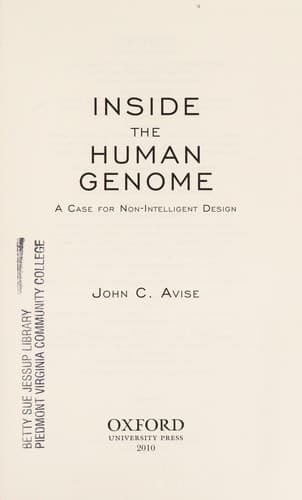
Inside the Human Genome: A Case for Non-Intelligent Design
داخل الجينوم البشري: حالة للتصميم غير الذكي
À l'intérieur du génome humain : Un argument pour un design non-intelligent
Editorial summary
This monograph presents a biological argument against intelligent design by examining molecular imperfections within the human genome. Avise, a distinguished evolutionary biologist, systematically documents genomic flaws and inefficiencies that he argues are incompatible with the hypothesis of an omnipotent, benevolent designer. The work directly challenges proponents of intelligent design theory, particularly those who claim that biological complexity necessarily implies purposeful creation.
The author employs a methodical survey of genetic defects, vestigial DNA sequences, and evolutionary remnants present in human genetics. Avise examines phenomena such as pseudogenes (non-functional gene copies), retrotransposons (parasitic DNA sequences), and the convoluted pathways of various metabolic processes. He demonstrates how these features make perfect sense within an evolutionary framework but appear inexplicable if one assumes deliberate design. The work particularly emphasizes how genetic diseases and congenital disorders arise from identifiable molecular failures that seem inconsistent with the work of a competent designer.
Central to Avise's approach is his engagement with theodicy, the theological problem of reconciling suffering with divine benevolence. He argues that genetic defects causing human suffering present a more acute challenge to intelligent design than traditional natural theology acknowledges. The author contends that evolutionary biology offers a more coherent explanation for these imperfections than does the hypothesis of divine creation. His analysis extends beyond simple cataloging of defects to explore how random mutations, genetic drift, and natural selection produce suboptimal solutions that nevertheless function adequately for survival and reproduction.
The work occupies a significant position in contemporary debates between scientific naturalism and religious explanations of biological origins. Unlike some critics of intelligent design who focus primarily on philosophical or methodological issues, Avise grounds his argument in extensive empirical evidence from molecular biology. He addresses not only fundamentalist creationism but also more sophisticated versions of design arguments, including those advanced by proponents of the intelligent design movement. The monograph serves both as a comprehensive introduction to genomic imperfections and as a sustained argument that these biological realities favor naturalistic over theistic explanations. While acknowledging that science cannot definitively disprove divine action, Avise maintains that the evidence strongly suggests that if a deity exists, it does not intervene in biological processes in the manner claimed by design theorists.
Argument formulations engaged
Related works
Avise, John (2010). Inside the Human Genome: A Case for Non-Intelligent Design. Oxford University Press.
@book{inside-the-human-genome-a-case-for-non-i,
  author    = {Avise, John},
  title     = {Inside the Human Genome: A Case for Non-Intelligent Design},
  year      = {2010},
  publisher = {Oxford University Press},
  url       = {https://god-database.com/en/works/inside-the-human-genome-a-case-for-non-intelligent-design-2010}
}