
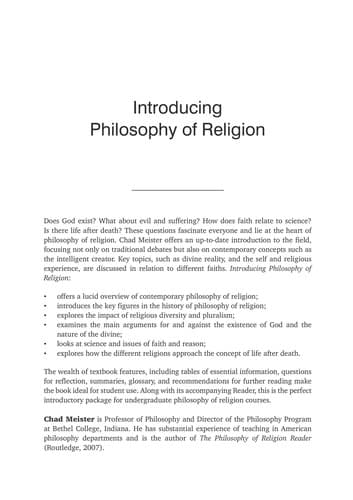
Introducing Philosophy of Religion
مقدمة في فلسفة الدين
Introduction à la philosophie de la religion
Editorial summary
This introductory textbook provides a comprehensive overview of core issues in philosophy of religion, offering students a balanced examination of fundamental questions about God's existence, nature, and relationship to humanity. Meister structures the work to guide readers through classical and contemporary debates while maintaining philosophical rigor accessible to newcomers.
The text begins by establishing philosophy of religion as a distinct discipline, explaining its methods of rational inquiry and argumentation. Meister emphasizes how philosophical analysis differs from theological confession or religious studies, focusing on critical evaluation of truth claims about divine reality. He introduces key concepts like natural theology, religious epistemology, and the problem of religious language that frame subsequent discussions.
Central chapters examine traditional arguments for God's existence, including cosmological, teleological, and ontological arguments. Meister presents each argument in its strongest historical formulations from thinkers like Aquinas, Paley, and Anselm, while incorporating modern refinements from philosophers such as Craig, Swinburne, and Plantinga. He carefully analyzes objections to each argument, drawing from critics like Hume, Kant, and contemporary atheist philosophers. The treatment remains evenhanded, allowing students to assess the merits of competing positions.
The work addresses the problem of evil as a major challenge to theistic belief, exploring both logical and evidential formulations. Meister surveys theodicies and defenses, including free will, soul-making, and skeptical theist responses. Additional chapters cover religious experience, miracles, and the relationship between faith and reason. The text also engages religious diversity, examining exclusivist, inclusivist, and pluralist approaches to conflicting truth claims across traditions.
Throughout, Meister employs a dialogical method that presents opposing viewpoints fairly while encouraging critical thinking. He includes primary source excerpts, study questions, and suggestions for further reading. The work serves its introductory purpose by mapping the conceptual terrain without advocating a particular position, though Meister occasionally indicates where he finds certain arguments more compelling.
This textbook makes a valuable contribution by providing an accessible yet philosophically sophisticated entry point to the discipline. It equips students with analytical tools and familiarity with major positions necessary for deeper engagement with philosophy of religion. The balanced presentation allows instructors from various perspectives to use the text while supplementing with their own emphases.
Argument formulations engaged
Meister, Chad (2009). Introducing Philosophy of Religion. Routledge.
@book{introducing-philosophy-of-religion-2009,
  author    = {Meister, Chad},
  title     = {Introducing Philosophy of Religion},
  year      = {2009},
  publisher = {Routledge},
  url       = {https://god-database.com/en/works/introducing-philosophy-of-religion-2009}
}