
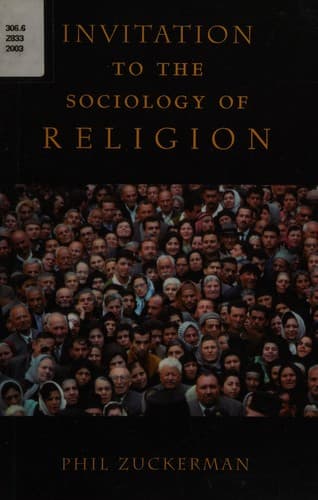
Invitation to the Sociology of Religion
دعوة إلى علم اجتماع الدين
Invitation à la sociologie de la religion
Editorial summary
This monograph serves as a comprehensive introduction to the sociological study of religion, examining how religious beliefs, practices, and institutions function within social contexts. Zuckerman approaches religion not as a theological or philosophical question but as a social phenomenon amenable to empirical investigation. The work systematically explores how sociologists analyze religious behavior, organizational structures, and the relationship between religion and various social forces.
The text examines classical sociological theories of religion, beginning with foundational thinkers like Durkheim, Weber, and Marx, who established different frameworks for understanding religion's social functions. Zuckerman presents Durkheim's view of religion as a source of social cohesion, Weber's analysis of religion's role in economic development and social change, and Marx's critique of religion as ideology. The work then transitions to contemporary sociological approaches, including rational choice theory, secularization thesis debates, and market models of religious competition.
A significant portion of the monograph addresses methodological approaches to studying religion sociologically. Zuckerman discusses various research methods including surveys, ethnographic studies, historical analysis, and comparative approaches. He examines how sociologists measure religiosity, analyze conversion patterns, study religious movements, and investigate the relationship between religion and social variables such as class, race, gender, and political affiliation.
The work explores key contemporary issues in the sociology of religion, including religious pluralism, fundamentalism, new religious movements, and the secularization debate. Zuckerman presents evidence both supporting and challenging the secularization thesis, examining variations in religious vitality across different societies. He analyzes how modernization, education, and scientific advancement interact with religious belief and practice in complex ways.
Throughout the text, Zuckerman maintains a descriptive, analytical approach that seeks to understand rather than evaluate religious phenomena. The work emphasizes empirical observation and theoretical explanation over normative judgments about religion's truth claims or value. This methodological stance reflects the broader sociological commitment to studying religion as a social fact, regardless of its ultimate truth or falsity.
The monograph contributes to the God debate by providing tools for understanding how beliefs about God function socially, how religious communities form and maintain themselves, and how secularization processes affect theistic belief. While not directly arguing for or against God's existence, the work illuminates the social conditions that support or challenge religious belief systems in modern societies.
Argument formulations engaged
Zuckerman, Phil (2003). Invitation to the Sociology of Religion. Routledge.
@book{invitation-to-the-sociology-of-religion-,
  author    = {Zuckerman, Phil},
  title     = {Invitation to the Sociology of Religion},
  year      = {2003},
  publisher = {Routledge},
  url       = {https://god-database.com/en/works/invitation-to-the-sociology-of-religion-2003}
}