
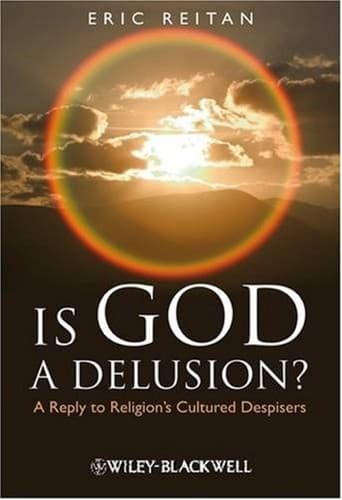
Is God a Delusion?
هل الإله وهم؟
Dieu est-il une illusion ?
Eric Reitan argues that Richard Dawkins's case against theism in 'The God Delusion' is philosophically flawed, and that belief in a morally perfect God is not only rationally permissible but positively supported by moral and existential considerations.
Editorial summary
Reitan's monograph emerges as a direct philosophical response to the New Atheist movement, particularly Richard Dawkins' The God Delusion. Writing from within the Christian analytic tradition, Reitan constructs a systematic defense of theistic belief while simultaneously critiquing what he perceives as the philosophical inadequacies of contemporary atheistic arguments. His work represents a significant contribution to early 21st century God debates by attempting to shift the discussion from polemics to rigorous philosophical analysis.
The text employs standard analytic philosophical methodology, proceeding through careful conceptual distinctions and logical argumentation. Reitan challenges Dawkins' central thesis that religious belief constitutes a harmful delusion by arguing that the New Atheist critique relies on a caricatured understanding of both religion and religious epistemology. He contends that Dawkins and similar critics conflate fundamentalist expressions of faith with sophisticated theological positions, thereby attacking a straw man rather than engaging with the strongest forms of theistic belief.
Central to Reitan's argument is his development of a cumulative case for theism that draws on multiple philosophical considerations. He examines the rationality of religious experience, the coherence of divine attributes, and the relationship between faith and reason. Unlike purely defensive apologetics, Reitan acknowledges legitimate criticisms of religion while maintaining that these do not undermine the rational credibility of belief in God. He particularly emphasizes the distinction between faith as blind adherence to dogma and faith as a rational response to experiential and philosophical evidence.
The work engages extensively with the problem of religious diversity and the challenge of conflicting truth claims among religions. Reitan proposes a form of religious pluralism that maintains the possibility of genuine theological truth while rejecting exclusivist claims to absolute certainty. This approach allows him to critique both dogmatic atheism and dogmatic theism as epistemologically overconfident positions.
Reitan's contribution lies not merely in defending theism but in elevating the quality of public discourse about religion. He demonstrates that serious philosophical engagement with questions about God requires moving beyond superficial generalizations and engaging with the actual arguments and experiences that ground religious belief. His work has influenced subsequent discussions in philosophy of religion by providing a model for how analytic philosophers can respond constructively to popular atheistic critiques while maintaining intellectual rigor.
Argument formulations engaged
Related works
Reitan, Eric (2008). Is God a Delusion?.
@book{is-god-a-delusion,
  author    = {Reitan, Eric},
  title     = {Is God a Delusion?},
  year      = {2008},
  url       = {https://god-database.com/en/works/is-god-a-delusion}
}