
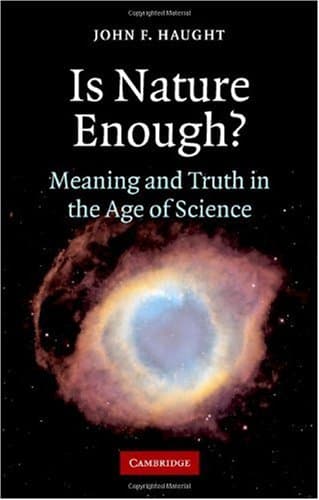
Is Nature Enough? Meaning and Truth in the Age of Science
هل الطبيعة كافية؟ المعنى والحقيقة في عصر العلم
La nature suffit-elle ? Sens et vérité à l'âge de la science
Editorial summary
John F. Haught's "Is Nature Enough?" presents a sustained theological critique of scientific naturalism, arguing that the reductionist worldview of contemporary science fails to account for fundamental dimensions of human experience. Writing from a Catholic perspective informed by process theology, Haught challenges the sufficiency of naturalistic explanations for understanding meaning, truth, and ultimate reality.
The work engages directly with prominent advocates of scientific naturalism, including Daniel Dennett, Richard Dawkins, and E.O. Wilson. Haught contends that their commitment to methodological naturalism has hardened into a metaphysical position that excludes legitimate questions about purpose, value, and transcendence. He argues that naturalism, despite its explanatory power in scientific domains, becomes self-defeating when extended to encompass all of reality, particularly in its attempts to explain consciousness, morality, and the human search for meaning.
Central to Haught's argument is his distinction between scientific explanation and understanding. While acknowledging science's legitimate autonomy in investigating natural phenomena, he maintains that scientific method alone cannot address why there is something rather than nothing, why the universe exhibits intelligibility, or why humans possess an apparently innate orientation toward truth, goodness, and beauty. These features of reality, Haught suggests, point beyond nature to a transcendent source.
The monograph develops a nuanced position that affirms both scientific inquiry and religious belief. Drawing on Bernard Lonergan's cognitional theory and Alfred North Whitehead's process philosophy, Haught proposes that authentic knowing involves multiple levels of explanation. He argues that theological understanding complements rather than competes with scientific knowledge, offering a more comprehensive account of reality that includes purpose and meaning.
Haught's contribution to the God debate lies in his sophisticated response to the new atheism's claim that science eliminates the need for religious explanation. He demonstrates how naturalistic materialism, when pursued consistently, undermines the very foundations of scientific rationality it claims to champion. The work offers theistic thinkers a philosophically rigorous framework for engaging scientific challenges to religious belief while respecting the integrity of scientific method. His emphasis on the self-transcending dynamism of human consciousness as evidence for divine reality provides a distinctive approach to natural theology that engages seriously with contemporary scientific understanding.
Argument formulations engaged
Related works
Haught, John F. (2006). Is Nature Enough? Meaning and Truth in the Age of Science. Cambridge University Press.
@book{is-nature-enough-meaning-and-truth-in-th,
  author    = {Haught, John F.},
  title     = {Is Nature Enough? Meaning and Truth in the Age of Science},
  year      = {2006},
  publisher = {Cambridge University Press},
  url       = {https://god-database.com/en/works/is-nature-enough-meaning-and-truth-in-the-age-of-science-2006}
}